
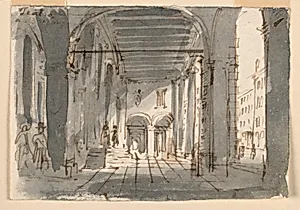
Portico at Entrance of Theatre at Brescia
early 19th century
Classification
theater
Department
Smithsonian Collection
Museum
Smithsonian American Art Museum
Credit
Museum purchase through gift of various donors and from Eleanor G. Hewitt Fund
Accession Number
1938-88-330
Rights
Public Domain
About this artwork
Research in Progress
Art Historical Context
Antonio Giuseppe Basoli (1774–1843), a prominent Italian architect and scenic designer, captured the grandeur of the portico at the entrance to the Theatre at Brescia in this early 19th work. Brescia, a northern Italian city with a rich theatrical heritage, was home to historic venues that embodied the era's Neoclassical revival, blending Roman-inspired columns and arches with elegant proportions. Basoli, known for his contributions to opera house designs and stagecraft across Italy, likely created this piece as a study or architectural rendering, highlighting the theater's role as a cultural hub during a time when public spectacles flourished amid post-Napoleonic reconstruction. Classified within the Smithsonian American Art Museum's theater collection, the artwork underscores Basoli's expertise in evoking drama through architecture. Though the medium remains unidentified amid ongoing research, such designs often employed precise line work or watercolor to convey spatial depth and light play—techniques essential for envisioning immersive theatrical environments. Acquired through museum purchase with donor gifts, it reflects enduring fascination with Europe's 19th-century stage worlds. This piece invites visitors to imagine the buzz of patrons arriving for performances, bridging Italy's artistic legacy with American collections. A testament to theater as communal art, it celebrates Basoli's vision of spaces where architecture meets storytelling.