
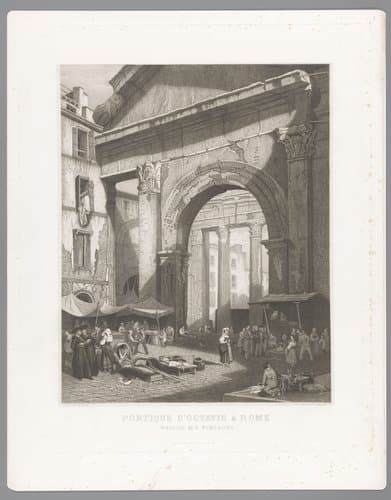
Portique d'Octavie à Rome; marché aux poissons
1833 - 1883
Medium
etching
Dimensions
418; 510
Rights
Public Domain
About this artwork
Prent behoort tot de prentserie: Dix eaux-fortes par A. Numans. Bij Hippert&Linnig wordt gesproken over een titelprent met de titel 'Six eaux-fortes (...)'. Waarschijnlijk gaat het om dezelfde prent als RP-P-1913-2243 want in de letter 'D' zijn contouren van een letter 'S' te zien. Mogelijk is de titelprent later aangepast om de prentserie uit te breiden van zes naar tien prenten.
Art Historical Context
Auguste Numans’s etching *Portique d’Octavie à Rome; marché aux poissons* invites viewers into a lively Roman scene framed by one of the city’s most evocative ancient monuments. Created between 1833 and 1883, the print depicts the Portico of Octavia, a first-century BCE structure originally dedicated by Emperor Augustus to his sister, now bustling with fish. The juxtaposition of monumental classical architecture and everyday commerce captures the nineteenth-century fascination with Rome as both a timeless ruin and a living city. Executed in etching, the work belongs to Numans’s series *Dix eaux-fortes*, originally conceived as six prints before the title plate was adapted—an alteration still visible in faint letterforms beneath the final “D.” The generous sheet size (510 × 418 mm) allows for rich detail in the shadowed arcades and the animated market foreground, demonstrating the medium’s capacity to translate both architectural precision and atmospheric life. As part of a traveling print series, this etching helped circulate images of Rome’s layered history to wider European audiences, blending archaeological interest with the charm of street-level observation. It remains a fine example of how nineteenth-century printmakers bridged past and present through intimate, reproducible views of the Eternal City.
About the Artist
Auguste Numans · 1822–1901
Auguste Numans (1822–1901) was a Belgian painter, draftsman, and printmaker whose career spanned the full breadth of Belgium's cultural golden age in the 19th century. Born on April 22, 1823, in Brussels (though some historical records suggest Antwerp), and dying on October 16, 1901, in Brussels, Numans worked during a period when Belgian art achieved international recognition through figures like...