
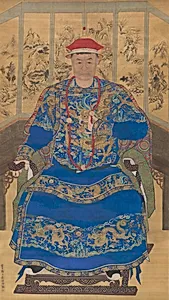
Portrait of a Manchu Prince
Qing dynasty (1644-1911), 17th century
Medium
Hanging scroll; ink and color on silk
Dimensions
Painting: 212.8 × 121.3 cm (83 3/4 × 47 3/4 in.); Mount: 298.5 × 138.5 cm (117 1/2 × 54 1/2 in.)
Department
Arts of Asia
Museum
Art Institute of Chicago
Accession Number
241750
Rights
Public Domain
About this artwork
Gu Jianlong completed this portrait after he became a court painter or “painter-in-waiting” for Emperor Shunzhi (reigned 1644–61) at the royal palace in Beijing. In its attention to fine detail, this portrait reflects the opulence of Gu’s surroundings at court. His sitter, a Manchu prince, sits on a gold lacquer chair wearing a blue court robe embroidered with a large four-clawed dragon on the chest; on the robe’s skirt, small dragons race over multicolored waves, clouds, water. His red hat has ...
Art Historical Context
This striking hanging scroll, created by the Chinese artist Gu Jianlong in the 17th century, captures a Manchu prince during the years of the Qing dynasty (1644–1911). Following the Manchu conquest of China, such portraits served to affirm the authority and cultural identity of the new ruling elite. The imposing scale—over seven feet tall—suggests it was designed for display in a grand hall or official setting, where it would convey dignity and lineage to viewers. Painted in ink and color on silk, the work exemplifies traditional Chinese techniques for formal portraiture. Silk provided a smooth, luminous surface ideal for delicate brushwork and subtle layering of pigments, allowing the artist to render rich robes, accessories, and an air of composed authority. These large hanging scrolls were not merely decorative but functioned as historical documents, preserving the appearance and status of important figures for posterity. As part of the Art Institute of Chicago’s Arts of Asia collection, this portrait offers a window into the intersection of Manchu and Chinese artistic traditions during a transformative era. It highlights how Qing rulers used visual representation to blend imperial power with established cultural forms.