
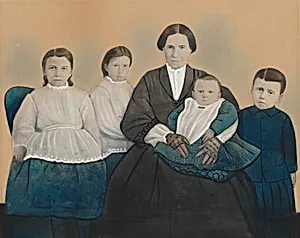
Portrait of a Mother and Four Children
Medium
salted paper print with applied color
Dimensions
image/sheet: 19.1 × 23.6 cm (7 1/2 × 9 5/16 in.) mount: 24.8 × 29.9 cm (9 3/4 × 11 3/4 in.)
Classification
Photograph
Department
CPH
Museum
National Gallery of Art, Washington, D.C.
Credit
Gift of Mary and Dan Solomon
Accession Number
2018.177.211
Rights
Public Domain
Art Historical Context
Step into the intimate world of mid-19th-century America with *Portrait of a Mother and Children*, a poignant salted paper print from the1850s, enhanced with delicate applied color. Created by an anonymous American photographer, this 7½ × 9⅜-inch image captures a tender family moment, likely posed in a studio to evoke domestic harmony. The soft hues added by hand bring warmth to the faces and clothing, transforming a stark early photograph into a lifelike keepsake. Salted paper prints, a pioneering wet-collodion process variant popular in the 1840s and 1850s, marked photography's shift from daguerreotypes to more affordable, reproducible images. This medium allowed middle-class families to commission portraits, democratizing portraiture beyond elite painters. The applied color technique—using watercolors or oils on the print's surface—lent a painted quality, bridging photography with traditional art forms and appealing to viewers accustomed to oil portraits. Housed in the National Gallery of Art's photography collection (gift of Mary and Dan Solomon), this work reflects Victorian ideals of motherhood and familial bonds amid America's expanding middle class. It offers a window into everyday lives preserved through innovative technology, reminding us how photography forever changed how we see and remember our loved ones.
About the Artist
American 19th Century · 1800–1900
The artist cataloged as "American, 19th Century" represents a collective of unidentified painters active in the United States during the nineteenth century, with 380 known artworks preserved in this virtual museum's collection. These works span a diverse array of genres typical of the era, including portraits, landscapes, still lifes, and genre scenes, reflecting the burgeoning artistic output of ...