
Portrait of Myself
1901
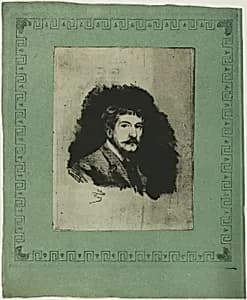
Medium
Drypoint with aquatint and plate tone, on ivory laid paper, tipped to one of the artist’s printed borders (a color proof printing of his softground and aquatint frame design titled Grecian Key and Fly)
Dimensions
Plate/sheet: 21.4 × 16.5 cm (8 7/16 × 6 1/2 in.); Secondary support: 34.6 × 28.5 cm (13 5/8 × 11 1/4 in.)
Classification
Department
Prints and Drawings
Museum
Art Institute of Chicago
Accession Number
180877
Rights
Public Domain
Art Historical Context
Theodore Roussel’s “Portrait of Myself” (1901) offers an intimate glimpse into the artist’s world at the turn of the twentieth century. A British painter and printmaker closely associated with James McNeill Whistler, Roussel excelled in etching and tonal printmaking techniques that bridged Impressionist sensibilities with the precision of the graphic arts. Here, he presents his own likeness through the rich, velvety lines of drypoint combined with the subtle tonal washes of aquatint and plate tone, creating a softly atmospheric self-portrait that feels both personal and painterly. The print’s presentation adds further layers of meaning. Roussel tipped the image onto one of his own decorative borders—a color proof of his softground and aquatint design titled *Grecian Key and Fly*—transforming the work into a unified object where frame and portrait converse. This inventive approach highlights his fascination with the total print, where technical experimentation and aesthetic harmony are equally valued. Measuring just over eight inches in height, the modest scale invites close viewing, rewarding the museum visitor with the delicate textures and quiet self-regard that define Roussel’s distinctive contribution to early modern printmaking.
About the Artist
Theodore Roussel · 1847–1926
Theodore Casimir Roussel was born on 23 March 1847 in Lorient, Brittany, France, into a naval family. After serving in the Franco-Prussian War, he began painting in 1872 as an entirely self-taught artist, initially rendering scenes of daily life in the meticulous style of the Old Masters. In 1878, he settled permanently in London, where he immersed himself in the vibrant British art scene. There, ...