
Portrait of Sanjō Kantarō in the Female Role of Yaoya Oshichi in the Play "Fuji no Takane" ("The High Peak of Mount Fuji")
ca. 1730–40
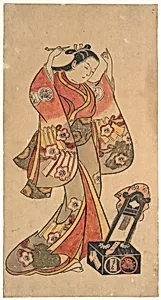
Medium
Tan-e (hand-colored print); ink and color on paper
Dimensions
H. 11 3/8 in. (28.9 cm); W. 6 in. (15.2 cm)
Classification
Prints
Culture & Period
Japan · Edo period (1615–1868)
Department
Asian Art
Museum
Metropolitan Museum of Art, New York, NY
Credit
Henry L. Phillips Collection, Bequest of Henry L. Phillips, 1939
Accession Number
JP2758
Rights
Public Domain
Tags
Art Historical Context
In the vibrant world of Edo-period Japan (1615–1868), this hand-colored print by Torii Kiyomasu II captures the theatrical flair of kabuki actor Sanjō Kantarō performing as Yaoya Oshichi, the passionate greengrocer's daughter from the play *Fuji no Takane* ("The High Peak of Mount Fuji"). Created around 1730–40, the artwork exemplifies *yakusha-e* (actor prints), a specialty of the Torii school, which popularized woodblock prints depicting star performers. Kiyomasu II's dynamic style highlights the *onna-gata* tradition—male actors masterfully embodying female roles, blending gender fluidity with dramatic intensity. This *tan-e* print, an early color technique using vermilion red (*tan*) as its dominant hue alongside ink and subtle pigments on paper, measures a intimate 11⅜ × 6 inches, perfect for collectors' albums or fans. The bold lines and expressive poses reflect ukiyo-e's ("pictures of the floating world") celebration of fleeting pleasures like theater. Oshichi's tragic tale of forbidden love and fiery fate resonated deeply, making such prints cultural icons that brought kabuki's glamour into everyday life. From the Metropolitan Museum of Art's Henry L. Phillips Collection, this piece invites us to appreciate how art bridged stage and street, immortalizing Japan's performative soul.
About the Artist
Torii Kiyomasu II · 1706–1763
At one point this artist was incorrectly identified as Kiyonobu II.