
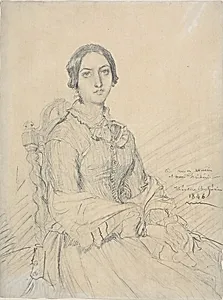
Portrait of the Baroness Chassériau
Medium
Graphite on cream wove paper
Dimensions
31.4 × 23.5 cm (12 3/8 × 9 5/16 in.)
Classification
graphite
Department
Prints and Drawings
Museum
Art Institute of Chicago
Accession Number
72529
Rights
Public Domain
About this artwork
The refinement and sensitivity of Chassériau's pencil portraits demonstrate clearly that he was the pupil of Ingres, the great master of this genre. Chassériau delighted in drawing the members of his family, and made this portrait of his cousin by marriage when he visited her home in Marseilles upon his return from Algiers in 1846.
Art Historical Context
In the hallowed halls of the Art Institute of Chicago's Prints Drawings department, Théodore Chassériau's *Portrait of the Baronessassériau* (1846) offers an intimate glimpse into the personal world of this prodigious French artist. At just 27 years old, Chassau—already celebrated as a pupil of Jean-Auguste-Dominique Ingres—ured the poised elegance of the Baroness, likely a family member, in a delicate graphite drawing on cream wove paper. Measuring a modest 31.4 × 23.5 cm, this work exemplifies his mastery of portraiture during the Romantic era, blending Ingresque precision with emerging emotional depth. Crafted in graphite, the medium allowed Chassériau to achieve subtle tonal gradations and fine hatching, creating a lifelike rendering that feels both formal and tenderly observed. Wove paper's smooth texture was ideal for such intricate line work, a technique prized in 19th-century preparatory studies that often bridged studio sketches and finished oils. This drawing highlights Chassériau's versatility, as he balanced classical idealism with the Romantic interest in individual character. Historically, the piece reflects mid-1840s Paris, a vibrant hub of artistic innovation where Chassériau navigated rival influences from Ingres and Eugène Delacroix. Though small in scale, it underscores his precocious talent—foreshadowing his tragic early death at 36—and invites visitors to appreciate the quiet power of graphite as a window into private lives.
About the Artist
Théodore Chassériau · 1819–1856
Théodore Chassériau was born on September 20, 1819, in El Limón, Samaná, in the Spanish colony of Santo Domingo — present-day Dominican Republic — to a French father and a Creole mother. The family relocated to Paris in 1820, and the young Chassériau's exceptional talent was evident almost immediately. At just eleven years old, in 1830, he was accepted into the prestigious studio of Jean-Auguste-D...