
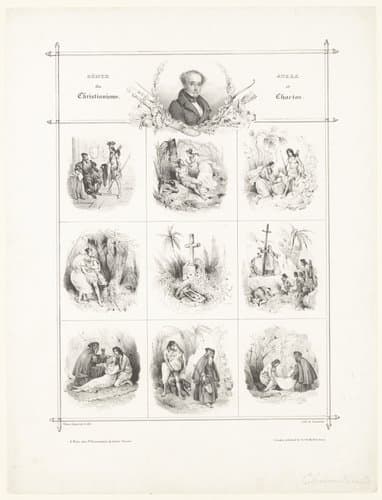
Portret van François-René de Chateaubriand en negen voorstellingen uit zijn roman 'Atala'
1834
Medium
lithography
Dimensions
361; 275
Rights
Public Domain
About this artwork
De serie bestaat uit twaalf prenten.
Art Historical Context
In 1834, French lithographer Victor Adam created *Portret van François-R de Chateaubri en negen voorstellingen zijn roman 'Atala*, a captivating series of twelve prints measuring 361mm by 275mm. This features a portrait of the renowned Romantic author François-René de Chubriand alongside nine vivid illustrations drawn from his 1801 novella *At*. Chateaubriand, a pivotal figure in French literature and politics, drew inspiration from his travels in North America for this tale of forbidden love between a Christian settler and a Native American warrior amid the wilds of 18th-century Louisiana, blending exotic adventure with profound emotional depth. Adam, active during the Romantic era, masterfully captured the novel's dramatic tension through lithography—a revolutionary 19th-century printing technique that allowed for intricate tonal gradations and fluid lines, mimicking the expressiveness of drawings. Popular for book illustrations and affordable reproductions, lithography democratized art, making literary scenes accessible to a wide audience. This series reflects the era's fascination with Romanticism's emphasis on nature, passion, and the exotic "other." As a cultural artifact, the prints bridge literature and visual art, immortalizing Chateaubriand's influence on European imagination and highlighting lithography's role in the visual storytelling boom of the 1830s. Visitors will appreciate how Adam's precise yet evocative style brings *Atala*'s lush landscapes and heartfelt moments to life.
About the Artist
Victor Adam · 1801–1866
Victor Adam was born in Paris in 1801 and built a prolific and commercially successful career as one of the leading lithographers and illustrators of nineteenth-century France. He received a conventional academic training in painting, but it was the new medium of lithography — still in its first decades of widespread use when Adam came of age — that provided the ideal vehicle for his gifts: a faci...