
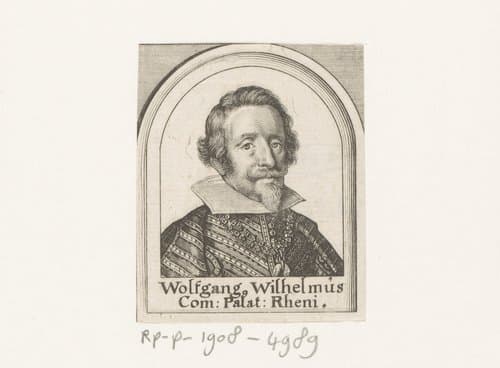
Portret van Wolfgang Willem van de Palts-Neuburg
1603 - 1650
Medium
engraving
Dimensions
68; 58
Rights
Public Domain
About this artwork
height 68 mm x width 58 mm
Art Historical Context
This delicate engraving, *Portret van Wolfgang Willem van de Palts-Neuburg*, captures the likeness of Wolfgang Wilhelm, Count Palatine of Neuburg, a prominent nobleman in the Holy Roman Empire during the early 17th century. Created by the renowned engraver Matthäus Merian the Elder (1593–1650), it exemplifies the artist's mastery in producing intricate portraits amid Europe's turbulent Baroque era. Merian, a Swiss-born master working primarily in Frankfurt, was celebrated for his topographical views and detailed reproductive prints, often collaborating with publishers to disseminate images of royalty and scholars across the continent. Measuring just 68 mm high by 58 mm wide, this miniature portrait highlights the technical prowess of engraving—a labor-intensive intaglio process where lines are incised into a metal plate, inked, and pressed onto paper to yield sharp, enduring details. Such small-scale works were highly prized in the 1600s for personal collections, books of nobility, or as affordable multiples, democratizing access to elite imagery during the Thirty Years' War. Wolfgang Wilhelm, who ruled as Elector Palatine from 1610, navigated religious and political upheavals, making this portrait a window into the era's aristocratic self-presentation. Merian's precise lines likely emphasize the sitter's dignified features and attire, underscoring engraving's role in preserving historical figures for posterity. A gem for print enthusiasts, it invites us to appreciate how tiny artworks carried immense cultural weight.