
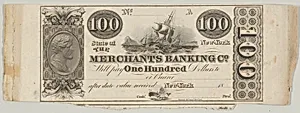
Proof of one side of a New York Merchants Banking Company 100 Dollar Bill
Medium
Engraving; proof
Dimensions
image: 3 1/8 x 7 5/16 in. (8 x 18.5 cm) sheet: 3 5/16 x 9 1/2 in. (8.4 x 24.2 cm)
Classification
Prints
Department
Drawings and Prints
Museum
Metropolitan Museum of Art, New York, NY
Credit
Gift of Joseph Veach Noble, 2002
Accession Number
2002.333.1
Rights
Public Domain
Tags
Art Historical Context
This engraving serves as a proof for one side of a $100 banknote issued by the New York Merchants Banking Company between 1824 and 1827. In the early nineteenth century, before the United States had a uniform national currency, individual banks produced their own paper money, making skilled engraving essential to deter counterfeiting. The detailed design, created by Asher B. Durand in collaboration with his brother Cyrus Durand and their firm, reflects the period’s blend of commercial necessity and artistic craftsmanship. Asher Brown Durand, later celebrated as a leading figure of the Hudson River School, began his career as an engraver. Here, the fine lines and intricate patterns demonstrate the precision required for banknote production, with Cyrus Durand’s innovations in mechanical engraving tools helping achieve the complex security features. The proof format allows viewers to appreciate the work before final printing, highlighting the meticulous process behind everyday objects like currency. Housed in the Metropolitan Museum’s Department of Drawings and Prints, this small yet significant piece (measuring just over three by seven inches) offers a glimpse into America’s financial and artistic history. Its donation by Joseph Veach Noble in 2002 underscores the enduring value of such prints as both functional designs and works of art.
About the Artist
Asher Brown Durand|A. B. & C. Durand & Company|Cyrus Durand · 1796–1886
Was a principal member of the Hudson River School. American artist; associated with the Hudson River School of landscape painting. Comment on works: Portraits