
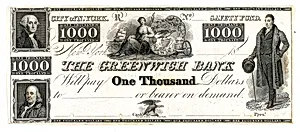
$1000 Bill for The Greenwich Bank, The City of New York
Medium
Engraving
Dimensions
sheet: 2 15/16 x 7 1/16 in. (7.5 x 18 cm)
Classification
Prints
Department
Drawings and Prints
Museum
Metropolitan Museum of Art, New York, NY
Credit
Harris Brisbane Dick Fund, 1917
Accession Number
17.3.3585(14)
Rights
Public Domain
Tags
Art Historical Context
Step into the bustling financial world of 1820s New York with this intricate engraving, *$1000 Bill for The Bank, The City of New York*, around 1828 by Asher B. Durand in collaboration with Durand, Perkins, and Company Measuring a compact 2 15/16 x 7 1/16 inches, this print exemplifies early American banknote design, where fine engravings served dual purposes: as legal tender and anti-counterfeiting masterpieces. Housed in the Metropolitan Museum of Art's Drawings and Prints department, it was acquired through the Harris Brisbane Dick Fund in 1917. Durand, later a luminary of the Hudson River School for his romantic landscapes, honed his skills here in meticulous line work—a hallmark of engraving. The bill likely features vigilant portraits of George Washington and Benjamin Franklin, evoking national trust and patriotism to assure holders of its authenticity. In an era before photography or modern printing, such vignettes demanded extraordinary precision; intricate patterns and vignettes deterred forgers while beautifying commerce. This artifact whispers of America's economic growing pains post-War of 1812, when private banks like Greenwich issued their own notes amid a patchwork currency system. A $1,000 denomination represented immense wealth—equivalent to tens of thousands today—highlighting engraving's role in building financial confidence. A charming glimpse into how art secured the young republic's prosperity!
About the Artist
Asher Brown Durand|Durand, Perkins, and Company · 1796–1886
Was a principal member of the Hudson River School. American artist; associated with the Hudson River School of landscape painting. Comment on works: Portraits