
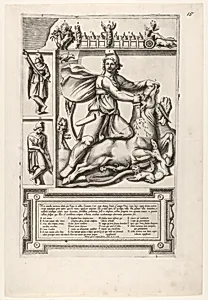
Relief with Mithras kneeling upon a bull and driving a sword into its shoulder, at left two smaller standing figures, one holding a sheathed sword and one holding a sword, a frieze with chariots and serpents coiled around figures above
Medium
Engraving
Dimensions
Plate: 15 15/16 x 10 3/8 in. (40.5 x 26.3 cm) Sheet: 19 5/16 x 13 1/16 in. (49 x 33.2 cm)
Classification
Prints
Department
Drawings and Prints
Museum
Metropolitan Museum of Art, New York, NY
Credit
Bequest of Phyllis Massar, 2011
Accession Number
2012.136.852
Rights
Public Domain
Tags
Art Historical Context
This intricate 16th-century engraving a classic scene from the ancient mystery religion of Mithraism the god Mithras kneeling triumphantly on a bull, plunging his sword into its shoulder in the ritual act known as the *tauroctony*. Flanking him are two smaller standing figures—one with a sheathed sword, other brandishing one—while a lively frieze above depicts chariots and serpents coiling around human forms. Scattered symbols like dogs, lions, crabs, and serpents evoke the zodiac and cosmic renewal, as the bull's blood was believed to generate life in Mithraic lore. Popular among Roman soldiers from the 1st to 4th centuries CE, Mithraism thrived in underground temples (*mithraea*), emphasizing secrecy, loyalty, and salvation. This print reproduces an ancient marble relief, reflecting Renaissance fascination with classical antiquity. Italian publisher Antonio Lafreri, active in Rome, specialized in such engravings, disseminating archaeological treasures to scholars and collectors. Engraved on a large plate (15 15/16 x 10 3/8 in.), the technique allows fine details—like the bull's tense muscles and serpents' sinuous forms—to shine, bridging ancient ritual and 16th-century humanism. A bequest to The Metropolitan Museum of Art in 2011, it invites us to ponder Mithras's enduring mystery.