
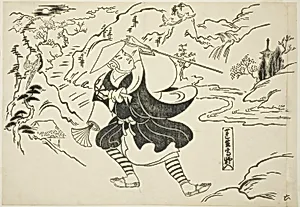
Rensho arriving at Mt. Koya (Rensho Koya-iri), from the series "Famous Scenes from Japanese Puppet Plays (Yamato irotake)"
c. 1705/06
Medium
Woodblock print; oban, sumizuri-e
Dimensions
27.1 × 39.4 cm (10 11/16 × 15 9/16 in.)
Classification
woodblock print
Department
Arts of Asia
Museum
Art Institute of Chicago
Accession Number
19603
Rights
Public Domain
Art Historical Context
Okumura Masanobu's *Rensho arriving at Mt. Koya (Rensho Koya-iri)*, created around 1705–06, captures a dramatic moment from Japan's vibrant tradition of puppet theater, or *bunraku*. Part of the series *F Scenes from Japanese Puppet Plays (Yamato irotake)*, this woodblock print the legendary figure Rensho's journey to the sacred Mt. Koya, a mountain retreat founded by the monk Kūkai in the 9th century and central to Shingon Buddhism. Masanobu, an innovative Edo-period artist active in early 18th-century Japan, drew from popular *joruri* narratives—chanted stories accompanying puppet performances—to bring these theatrical tales to a wider audience through affordable prints. Printed in the *sumizuri-e* style—a striking monochrome technique using black ink (*sumi*) on paper—this *oban*-sized work (27.1 × 39.4 cm) exemplifies the technical precision of early woodblock printing. Masanobu's bold lines and subtle shading evoke the shadowy drama of puppet stages, where carved wooden dolls and live narrators mesmerized crowds. As one of the first artists to mass-produce such images, he helped lay the groundwork for the explosive popularity of *ukiyo-e*, transforming elite theater scenes into everyday art. Housed in the Art Institute of Chicago's Arts of Asia collection, this print offers a window into Genroku-era (1688–1704) culture, when puppet plays rivaled kabuki in fame. It reminds us how woodblock prints democratized storytelling, blending spirituality, adventure, and performance in a single, timeless image.
About the Artist
Okumura Masanobu · 1686–1764
Japanese, 1686–1764