
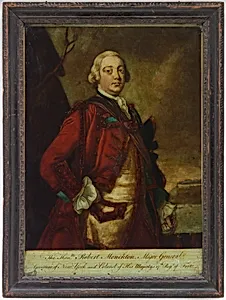
Robert Monckton
c. 1761-70
Medium
Classification
Department
Smithsonian Collection
Museum
Smithsonian American Art Museum
Credit
National Portrait Gallery, Smithsonian Institution
Accession Number
NPG.89.199
Rights
Public Domain
Tags
Art Historical Context
This portrait print depicts Robert Monckton, a prominent British Army major general and colonial statesman during the mid-18th century. by an unidentified artist around 1761-70, it captures Monckton at the height of his influence, likely commemorating his military exploits in the Seven Years' War and his role as Governor of Nova Scotia As a key figure in Britain's North American campaigns, including the capture of Louisbourg in 1758, Monckton symbolized imperial ambition and colonial governance. The artwork's medium as a print was significant in the era, allowing for widespread reproduction and distribution of prestigious portraits. Unlike original paintings, prints democratized access to images of elites, fostering public familiarity with leaders like Monckton amid growing transatlantic tensions. Housed in the Smithsonian American Art Museum's National Portrait Gallery collection, it exemplifies how visual culture reinforced British authority in the colonies. Though the artist's identity remains unknown, the portrait's formal style reflects 18th-century conventions, emphasizing Monckton's dignified bearing and military stature. Visitors will appreciate its window into pre-Revolutionary America, where such images bridged art, politics, and power.