
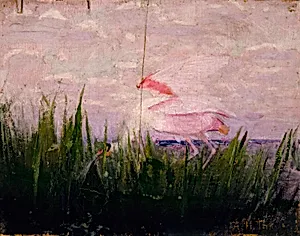
Roseate Spoonbill, study for book Concealing Coloration in the Animal Kingdom
ca. 1905-1909
Medium
Painting
Classification
Painting
Department
Smithsonian Collection
Museum
Smithsonian American Art Museum
Credit
Smithsonian American Art Museum, Gift of the heirs of Abbott Handerson Thayer
Accession Number
1950.2.4
Rights
Public Domain
Tags
About this artwork
In 1909, Abbott Handerson Thayer and his son, Gerald, published a controversial book titled Concealing Coloration in the Animal Kingdom, offering their theory of animal camouflage. Thayer believed that the coloration of animals, no matter how eye-catching, was meant to disguise them in nature through what he called "countershading." Even bright pink flamingoes would vanish against a similar colored sky at sunset or sunrise. No matter that at times their brilliant feathers were highly visible, th...
Art Historical Context
Abbott Handerson Thayer's *Roseate Spoonbill, study for book Concealing Coloration in the Animal Kingdom* (ca. 1905-1909) is a captivating painting that bridges art and science. Created as a preparatory study for the controversial 1909 book co-authored with his son Gerald, it explores Thayer's pioneering theory of animal camouflage. Thayer, an American painter known for his naturalist style, argued that even vibrant colors in nature serve protective purposes through "countershading"—a gradation of tones that makes animals blend seamlessly into their surroundings. In this work, the roseate spoonbill's striking pink plumage, set against grass, water, and sky-like hues (evoking tags of flamingo imagery), exemplifies Thayer's bold claim: brilliant birds vanish against colorful sunrises or sunsets. He posited that predators might "see right through" these opaque creatures at critical moments, challenging conventional views on visibility in the wild. This painting, now in the Smithsonian American Art Museum (gift of Thayer's heirs), highlights how Thayer blended meticulous observation with artistic precision to advocate for nature's hidden genius. Thayer's ideas influenced early 20th-century biology and military camouflage, making this study a fascinating artifact of interdisciplinary innovation. Visitors will appreciate its blend of beauty and intellect, inviting a fresh look at the natural world.