
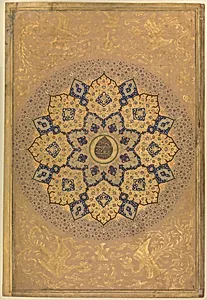
Rosette Bearing the Name and Title of Emperor Aurangzeb (Recto), from the Shah Jahan Album
recto: ca. 1658; verso: ca. 1630–40
Medium
Ink, opaque watercolor, and gold on paper
Dimensions
H. 15 3/16 in. (38.6 cm) W. 10 7/16 in. (26.5 cm)
Classification
Codices
Department
Islamic Art
Museum
Metropolitan Museum of Art, New York, NY
Credit
Purchase, Rogers Fund and The Kevorkian Foundation Gift, 1955
Accession Number
55.121.10.40
Rights
Public Domain
Art Historical Context
Behold the exquisite *Rosette Bearing the Name Title of Emperor Aurang (Recto), from Shah Jahan Album*, stunning page crafted by the master calligrapher Mir 'Ali Har. Created around 1658 on the recto—with the verso dating to circa 1630–40—this artwork hails from the opulent Mughal court of India. The Shah Jahan Album, for the emperor famed for the Taj Mahal, was a prestigious collection of calligraphy and illuminations, showcasing the empire's artistic pinnacle during its golden age. Rendered in ink, opaque watercolor, and shimmering gold on paper (measuring 15 3/16 x 10 7/16 inches), the rosette design elegantly encircles the name and titles of Aurangzeb, Shah Jahan's successor who ascended in 1658. Mir 'Ali Haravi, from Herat, exemplifies nasta'liq script's fluid grace, a hallmark of Persian-influenced Islamic calligraphy prized in Mughal ateliers. The lavish use of gold and vibrant pigments highlights the technical virtuosity of miniature painting traditions, where precision met poetic beauty. As part of the Metropolitan Museum of Art's Islamic Art collection (acquired in 1955), this codex folio reflects Mughal patronage's cultural zenith—blending devotion, imperial pride, and artistry. Visitors, imagine emperors treasuring such pages as symbols of power and piety!