
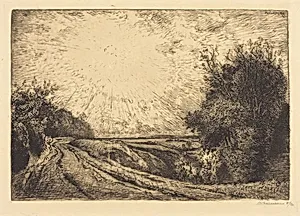
Route from La Houssoye, Crevecoeur-le-Grand (Route de La Houssoye, Crevecoeur)
1913
Medium
etching
Classification
Department
CG-E
Museum
National Gallery of Art, Washington, D.C.
Credit
Rosenwald Collection
Accession Number
1943.3.5563
Rights
Public Domain
Art Historical Context
Auguste Lepère's *Route from La Housso, Crevecoeur-le-Grand* (1913) captures the serene beauty of rural France through the delicate art of etching. Created on the eve of World War I, this print depicts a winding country road near Crevecoeur-le-Grand, evoking the everyday charm of the French countryside. Lepère, a prominent French printmaker of the late 19th and early 20th centuries, was renowned for his masterful etchings that blended realism with atmospheric subtlety, often drawing from his travels through Normandy and Picardy. Etching, Lepère's preferred medium, involves incising lines into a metal plate with acid, allowing for intricate textures and tonal depth that mimic the play of light on foliage and distant hills. His style reflects the influence of Impressionism's outdoor motifs while emphasizing precise draftsmanship, making this work a fine example of how printmaking democratized fine art during the Belle Époque. Housed in the National Gallery of Art's Rosenwald Collection—a treasure trove of graphic arts—this piece highlights Lepère's contribution to elevating prints as standalone artworks. Visitors will appreciate its quiet poetry, inviting reflection on a vanishing pastoral world preserved in ink and copper.
About the Artist
Auguste Lepère · 1849–1918
Auguste-Louis Lepère (1849–1918), son of the sculptor François Lepère, was born in Paris on November 30, 1849, into an artistic family that shaped his early path. At age thirteen, he apprenticed in the Paris studio of the English wood engraver Joseph Burn Smeeton, honing his skills in wood engraving until 1867. He furthered his training with drawing classes under Horace Lecoq de Boisbaudran at the...