
Running Horse Weather Vane
c. 1860
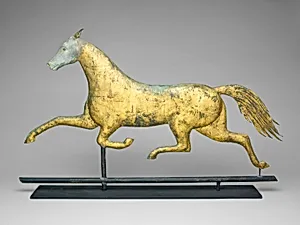
Medium
Copper, lead or zinc, and gilding
Dimensions
43.2 × 69.2 × 5.1 cm (17 1/16 × 27 1/4 × 2 1/16 in.)
Classification
weathervane
Department
Arts of the Americas
Museum
Art Institute of Chicago
Accession Number
188559
Rights
Public Domain
About this artwork
Before the advent of modern mechanized devices, weather vanes were an important source of information on shifting weather conditions. The horse shape was common; in fact, weather vanes often memorialized famous racehorses. The elegant simplicity of this example is characteristic of the works of Alvin L. Jewell, one of the most important 19th-century weather vane designers. At his metal manufacturing firm, A. L. Jewell and Company, Jewell invented a molding process so that he could mass-produce h...
Art Historical Context
Created around 1860 by Alvin L. Jewell, this Running Horse Weather Vane captures the spirit of mid-19th-century American craftsmanship. As a functional yet decorative object, it would have perched atop a barn or public building, its dynamic pose indicating wind direction while delighting passersby with its sense of motion and vitality. The horse, a symbol of speed and rural life, reflects the era’s fascination with both agriculture and emerging transportation. Crafted from copper with lead or zinc accents and finished in gilding, the weathervane combines durability with visual brilliance. The gilding would have caught sunlight, making the sculpture gleam from a distance—an essential quality for rooftop ornaments. Measuring just over two feet long, its compact yet expressive form exemplifies the balance between utility and artistry in American folk traditions. Housed in the Art Institute of Chicago’s Arts of the Americas collection, this piece highlights how everyday objects became expressions of national identity and ingenuity during a period of rapid expansion and change.