
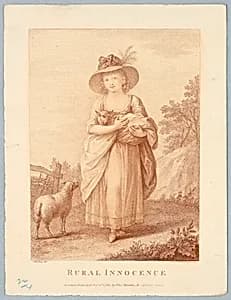
Rural Innocence
Classification
Department
Smithsonian Collection
Museum
Smithsonian American Art Museum
Credit
Bequest of Erskine Hewitt
Accession Number
1938-57-809
Rights
Public Domain
About this artwork
Research in Progress
Art Historical Context
**Rural Innocence** (1785) is a delicate print by Francesco Bartol, an Italian engraver for his work in England during the late 18th century Born in Florence in 1727, Bartolozzi a pivotal figure in British printmaking after moving to London in 1764, where he served as engraver to King George III. Active until his death in 1815, he in reproductive prints that captured the elegance of contemporary paintings, often evoking the Rococo spirit of grace and whimsy transitioning into Neoclassicism. The title suggests a pastoral scene celebrating the purity and simplicity of rural life—a popular theme in Georgian-era art that romanticized the countryside amid rapid urbanization. As a print, this work exemplifies Bartolozzi's mastery of stipple engraving, a technique using dotted lines to create soft, tonal effects mimicking watercolor or chalk drawings. This innovative method made fine art more accessible to a wider audience through affordable reproductions, bridging elite patronage and public appreciation. Housed in the Smithsonian American Art Museum as part of the Smithsonian Collection (bequest of Erskine Hewitt), it reflects the era's fascination with innocence and nature, offering visitors a glimpse into 18th-century ideals of harmony and virtue. Though research continues, *Rural Innocence* invites us to ponder timeless contrasts between rustic idyll and modern complexity. (198 words)