
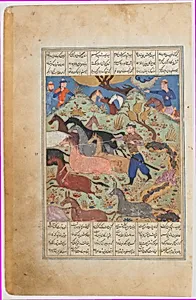
"Rustam Lassos Rakhsh", Folio from a Shahnama (Book of Kings)
ca. 1450
Medium
Ink and opaque watercolor on paper
Dimensions
Page: H. 10 1/4 in. (26.1 cm) W. 6 5/8 in. (16.8 cm) Text and painting box: H. 7 1/2 in. (19 cm) W. 5 in. (12.7 cm) Painting: H. 5 3/16 in. (13.1 cm) W. 4 11/16 in. (11.9 cm)
Classification
Codices
Department
Islamic Art
Museum
Metropolitan Museum of Art, New York, NY
Credit
Rogers Fund, 1972
Accession Number
1972.285.2
Rights
Public Domain
Tags
Art Historical Context
Behold the dynamic folio *"Rustam Lassos Rakhsh"* from a *Shahnama* (Book of Kings), a lavishly illustrated 15th-century manuscript of Abu'l Qasim Firda's epic poem, created around 1450. This scene captures the legendary Persian hero Rustam skillfully lassoing his faithful steed Rakhsh amid a rugged landscape dotted with men, horses, and donkeys. The *Shahnama*, completed in 1010 CE, chronicles Iran's mythical kings and heroes, blending history, legend, and moral tales in over 50,000 verses—a cornerstone of Persian identity. Crafted in the Persian miniature tradition, this work employs ink outlines and vibrant opaque watercolors on paper, achieving jewel-like intensity in a compact painting measuring just 5 3/16 by 4 11/16 inches. Typical of Timurid-era manuscripts from workshops in Herat or Shiraz, it features flattened perspective, intricate patterns on clothing and animals, and a rhythmic composition that conveys motion and drama. The surrounding text box integrates poetry seamlessly with imagery, exemplifying the codex format's fusion of literature and art. Housed in the Metropolitan Museum of Art's Islamic Art Department (acquired via Rogers Fund, 1972), this folio highlights the cultural flourishing of Persianate arts under 15th-century patronage. It invites us to marvel at Rustam's heroism while appreciating how such miniatures preserved epic narratives for royal audiences, bridging storytelling and visual splendor across centuries.
About the Artist
Abu'l Qasim Firdausi · 935–1020
Abu'l Qasim Firdausi, born around 940 in the village of Paj near Tus in Khorasan (modern-day Iran), emerged from a family of landed gentry known as dehqans, who preserved ancient Iranian oral traditions amid the cultural renaissance of the Samanid Empire. Little is documented about his early life or formal training, though he likely received a basic education including Arabic literacy, immersing h...