
Saigyo Hoshi gazing at Mt. Fuji
c. 1730s
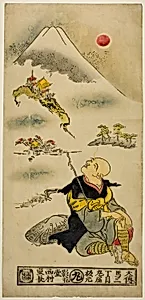
Medium
Hand-colored woodblock print; hosoban, urushi-e
Dimensions
34 × 16.2 cm (13 3/8 × 6 3/8 in.)
Classification
Department
Arts of Asia
Museum
Art Institute of Chicago
Accession Number
44176
Rights
Public Domain
Art Historical Context
In the serene woodblock print *Saigyo Hoshi Gazing at Mt. Fuji created around the 1730s by Nishimuraigenaga, we encounter a poignant moment from Japanese literary tradition. Saigyo Hoshi, the revered 12th-century poet-monk, stands contemplatively before the majestic snow-capped peak of Mt. Fuji, embodying the waka poet's deep reverence for nature's sublime beauty. Shigenaga, an early ukiyo-e master associated with the Torii school captures this timeless scene in a narrow hosoban format—ideal for intimate, portable viewing—blending spiritual introspection with the "floating world" aesthetic of Edo-period Japan. This hand-colored urushi-e print showcases innovative techniques of its era: lacquer-like glue (urushi) applied to the woodblocks creates a glossy, jewel-toned sheen, enhancing the luminous quality of Fuji's slopes and Saigyo's flowing robes. Predating the vibrant multicolored nishiki-e prints, urushi-e represents a transitional phase in ukiyo-e evolution, where bold lines and subtle hand-coloring evoked emotional depth on a modest scale of just 34 × 16.2 cm. Culturally, the work reflects Japan's enduring fascination with Mt. Fuji as a sacred symbol of impermanence and purity, echoing Saigyo's own verses. Housed in the Art Institute of Chicago's Arts of Asia collection, it invites visitors to pause and ponder the harmony between human spirit and natural grandeur.
About the Artist
Nishimura Shigenaga · 1690–1758
Nishimura Shigenaga (c. 1697–1756) was a pioneering Japanese ukiyo-e printmaker born in Edo (modern-day Tokyo), where he initially worked as a landlord in the Tōriabura-chō district before relocating to Kanda-Sakumachō to operate a bookshop. Self-taught with no known formal teacher, he immersed himself in art around 1719, drawing early inspiration from the Torii school's yakusha-e (actor portraits...