
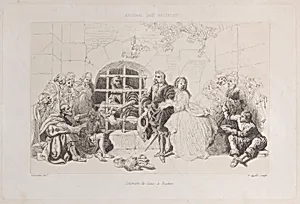
Salamon de Caus at Bicêtre
Medium
Etching
Dimensions
Plate: 6 7/16 × 9 3/4 in. (16.4 × 24.8 cm) Sheet: 8 3/4 in. × 11 in. (22.3 × 28 cm)
Classification
Prints
Department
Drawings and Prints
Museum
Metropolitan Museum of Art, New York, NY
Credit
Gift of Georgiana W. Sargent, in memory of John Osborne Sargent, 1924
Accession Number
24.63.1261
Rights
Public Domain
Tags
Art Historical Context
This etching, *Salamon de Caus atêtre*, captures a poignant moment from 17th-century French history, likely created by Jacques Courtois (known as *le Bourguignon*), Baroque artist renowned for his dynamic battle scenes and masterful prints. Produced between 1640 and 1676, it depicts the engineer and inventor Salomon de Caus amid figures at the infamous Bicêtre hospital near Paris, a site notorious as both a prison and asylum. The title suggests a focus on de Caus, whose innovative designs for hydraulic gardens and automata earned him fame before his confinement, blending portraiture with social commentary on institutional life. Etching's fine, fluid lines—achieved by biting acid into a metal plate—lend the work its intricate detail and expressive quality, ideal for conveying the bustle of men and women in the scene. Measuring a modest plate size of 6 7/16 × 9 3/4 inches, this print exemplifies the accessibility of 17th-century reproductive art, allowing wide dissemination of historical vignettes. Housed in the Metropolitan Museum of Art's Drawings and Prints department since a 1924 gift, it invites reflection on genius, madness, and the era's fascination with human endeavor.
About the Artist
Jacques Courtois|Salomon de Caus|Jacques-Joseph Lécurieux · 1621–1676
A specialist in battle paintings, he also painted religious and other scenes. As a teenager, Courtois left France for Italy with his young brother, Guillaume. He drew military campaigns, then studied in Bologna, Florence, and Siena, arriving in Rome by 1638. He worked primarily in Italy. He joined the Jesuit order in 1657.