
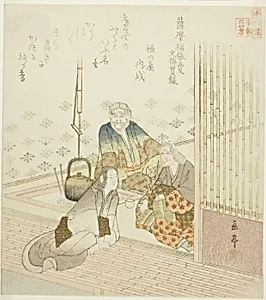
Satsuma no Fukuyorime from the Veritable Records of Emperor Montoku (Satsuma no Fukuyorime, Montoku jitsuroku), from "Twenty-four Japanese Paragons of Filial Piety for the Honcho Circle (Honchoren Honcho nijushiko)"
c. 1821
Medium
Color woodblock print; shikishiban, surimono
Dimensions
21.4 × 19.3 cm (8 7/16 × 7 5/8 in.)
Classification
woodblock print
Department
Arts of Asia
Museum
Art Institute of Chicago
Accession Number
37569
Rights
Public Domain
Art Historical Context
Discover the exquisite *Satsuma no Fukime from the Veritable of Emperor Montoku*, color woodblock print by Yashima Gakutei, created around 1821. This intimate shikishiban surimonomeasuring just 21.4 × 19.3 cm— to the series *Twenty-four Japanese Paragons Filial Piety for Honcho Circle*. Gakutei, a master of the Kyoto-Osaka ukiyo-e tradition, specialized in these luxurious, privately commissioned prints, often produced for poetry circles like the Honcho Circle celebrate virtues through art. Surimono elevated woodblock printing with refined techniques: vibrant colors layered precisely, subtle embossing (gauffrage), and metallic mica for a shimmering effect, making each print a collector's gem. Here, Gakutei illustrates Satsuma no Fukuyorime, a figure from Emperor Montoku's historical records (9th century), embodying filial piety—a core Confucian ideal blending Japanese history with moral instruction. These works popularized native Japanese exemplars, adapting China's famous 24 Paragons motif for Edo-period audiences. Held in the Art Institute of Chicago's Arts of Asia collection, this print captivates with its delicate composition and cultural depth, inviting reflection on loyalty and heritage in Japan's artistic golden age.
About the Artist
Yashima Gakutei · 1786–1868
Yashima Gakutei (c. 1786–1868), born in Osaka as the illegitimate son of a Tokugawa shogunate samurai named Hirata, adopted the name from his mother's subsequent marriage into the Yashima clan. Little is documented about his early years beyond these familial ties, but he pursued artistic training under the esteemed ukiyo-e masters Totoya Hokkei and Katsushika Hokusai, absorbing their precision in ...