
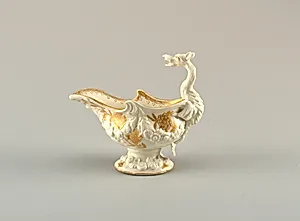
Sauceboat (One of a Pair)
Classification
ceramics
Department
Smithsonian Collection
Museum
Smithsonian American Art Museum
Credit
Museum purchase from Charles E. Sampson Memorial Fund
Accession Number
1979-18-2
Rights
Public Domain
About this artwork
Research in Progress
Art Historical Context
This elegant sauceboat, one of a pair crafted by England's Bow Porcelain Manuf around 1750, exemplifies the-18th-century boom in British ceramics. Founded in London's Bow district about 1744, the manufactory was a pioneering force in producing affordable soft-paste porcelain, bone-ash formula that mimicked the translucent glow of coveted Chinese and Meissen wares. During the Georgian era, such tableware became status symbols for the growing middle class, blending functionality with luxury at dinner parties. As a ceramic vessel designed for serving sauces, this piece highlights Bow's skill in shaping delicate, boat-like forms—practical yet refined, often adorned with molded rococo details or painted motifs (though specifics await further research). Soft-paste porcelain allowed for intricate modeling and firing at lower temperatures, making high-style dinner services accessible beyond elite circles. Acquired through the Smithsonian American Art Museum's Charles E. Sampson Memorial Fund, it reflects transatlantic tastes, bridging British innovation with American collecting. Though research continues, this sauceboat invites us to savor the artistry of early industrial porcelain, a testament to England's creative rivalry with European porcelain giants.