
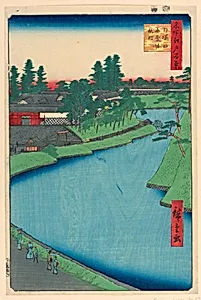
Scene of the Moat
1797-1858
Medium
landscapes
Classification
landscapes
Department
Smithsonian Collection
Museum
Smithsonian American Art Museum
Credit
Gift of the Estate of Mrs. Robert H. Patterson
Accession Number
1941-31-257
Rights
Public Domain
About this artwork
Research in Progress
Art Historical Context
Ando Hiroshige (1797–1858) was a master of ukiyo-e, the Japanese woodblock print tradition that flourished during the Edo period (1603–1868). Renowned for his evocative landscapes, Hiroshige captured the transient beauty of nature and everyday scenes with poetic sensitivity. *Scene of the Moat*, of the Smithsonian American Art's collection, exemplifies his focus on serene, atmospheric vistas—likely depicting a tranquil moat scene, a motif evoking Japan's castle landscapes and watery fortifications. Hiroshige's genius lay in his innovative use of perspective, bold color gradients, and subtle atmospheric effects, achieved through collaborative woodblock printing techniques. These prints, affordable and widely circulated, brought the splendor of Japan's countryside to urban audiences, blending realism with emotional resonance. This work, gifted from the Estate of Mrs. Robert H. Patterson, highlights the global appeal of ukiyo-e, which later inspired Western artists like Van Gogh and Monet. Though research continues, *Scene of the Moat* invites us to ponder Hiroshige's enduring legacy: transforming humble moats into portals of quiet wonder. (198 words)