
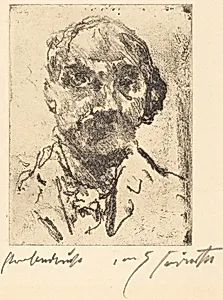
Selbstbildnis (Self-Portrait)
1921/1922
Medium
softground etching on wove paper
Dimensions
plate: 12 x 9 cm (4 3/4 x 3 9/16 in.) sheet: 26.5 x 19.8 cm (10 7/16 x 7 13/16 in.)
Classification
Department
CG-W
Museum
National Gallery of Art, Washington, D.C.
Credit
Ailsa Mellon Bruce Fund
Accession Number
1985.32.1
Rights
Public Domain
Art Historical Context
Lovis Corinth's *Selbstbildnis* (Self-Portrait), around 1921/1922, captures the German artist's introspective gaze in the final years of his life. A pivotal figure in late 19th- and early 20th-century German art, Corinth bridged Impressionism's luminous effects with Expressionism's raw emotional intensity. By this time, in his mid-60s and recovering from a debilitating stroke a decade earlier, his self-portraits often revealed a vulnerability and unflinching honesty, reflecting both personal mortality and the era's post-World War I disillusionment. Rendered as a softground etching on wove paper, this intimate print measures just 12 x 9 cm on the plate, emphasizing its private, almost confessional nature. Softground etching, a technique Corinth mastered, uses a yielding ground that captures textured, velvety lines—mimicking the fluidity of drawing or oil paint. This allowed for expressive mark-making, blending precision with spontaneity, and made prints accessible for wider appreciation during a time when original paintings were elite luxuries. Acquired through the Ailsa Mellon Bruce Fund for the National Gallery of Art's print collection, this work exemplifies Corinth's late mastery of graphic media. Visitors are drawn to its psychological depth, a poignant reminder of art's power to confront the human condition with unflinching candor.
About the Artist
Lovis Corinth · 1858–1925
Lovis Corinth, born Franz Heinrich Louis on July 21, 1858, in Tapiau, East Prussia (now Gvardeysk, Russia), to a tanner father, displayed prodigious drawing talent from childhood. He began formal training at the Königsberg Academy in 1876, then moved to the Academy of Fine Arts in Munich from 1880 to 1884, studying under Ludwig von Löfftz and briefly Franz von Defregger, where he absorbed a Realis...