
Seneca Steele, a Great Libertine
1831
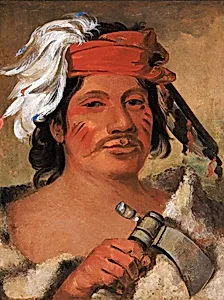
Medium
Painting
Classification
Painting
Department
Smithsonian Collection
Museum
Smithsonian American Art Museum
Credit
Smithsonian American Art Museum, Gift of Mrs. Joseph Harrison, Jr.
Accession Number
1985.66.269
Rights
Public Domain
Tags
About this artwork
George Catlin described Seneca Steele as having a “hatchet in his hand.” The artist probably took this portrait in Washington, in February 1831. (Catlin, 1848 Catalogue, Catlin’s Indian Gallery, SAAM online exhibition)
Art Historical Context
**Seneca Steele, a Greatine** (1831) is a striking portrait by George Catlin, the pioneering American artist renowned for his vivid documentation of Native American life. Catlin, who traveled extensively in the 1830s to capture Indigenous peoples before their cultures faced irreversible change, painted this work in oil, showcasing his signature style of direct, dignified portraiture. The subject, Seneca Steele—a member of the Seneca Nation—is depicted with a commanding presence, holding a hatchet in his hand, as noted by Catlin himself in his 1848 *Catalogue* for *Catlin’s Indian Gallery*. Likely created in Washington, D.C., in February 1831, the painting captures a moment when Native leaders visited the capital for negotiations amid growing U.S. expansion pressures. This portrait reflects Catlin's mission to portray Native Americans as individuals of strength and character, countering stereotypes prevalent in 19th-century America. Housed in the Smithsonian American Art Museum (gift of Mrs. Joseph Harrison, Jr.), it exemplifies Catlin's broader legacy: over 500 works forming one of the earliest comprehensive visual records of Indigenous nations. For visitors, it offers a window into a pivotal era of cultural encounter and the artist's urgent call to preserve vanishing traditions.
About the Artist
George Catlin · 1796–1872
George Catlin (1796–1872), born in Wilkes-Barre, Pennsylvania, to Putnam Catlin and Polly Sutton—who had been captured by Native Americans during the 1778 Battle of Wyoming—initially pursued a legal career. Trained at Litchfield Law School, he was admitted to the bar in 1819 but abandoned law after two years to study art in Philadelphia in 1823. Self-taught as a portraitist, Catlin quickly gained ...