
Medium
Classification
Department
Smithsonian Collection
Museum
Smithsonian American Art Museum
Credit
National Portrait Gallery, Smithsonian Institution
Accession Number
NPG.71.53
Rights
Public Domain
Tags
About this artwork
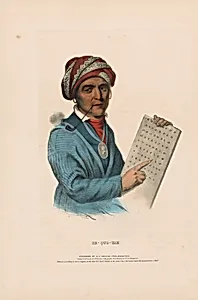
Sequoyah, the son of a Cherokee woman and a fur trader from Virginia, was a warrior, a hunter, and a silversmith. For twelve years he worked to devise a method of writing for the Cherokee language. His syllabary of eighty-five symbols representing syllables was approved by the Cherokee chiefs in 1825. The straightforward system made possible a rapid spread of literacy throughout the Cherokee Nation. The Cherokee also began to create written documents, including a constitution in 1827. The follow...
Art Historical Context
**Sequoyah** Lithograph by J. T. Bowenography Company, 183 Smithsonian American Art Museum This striking 1837 lithograph portrait, produced by the J. T. Bowenography Company, captures Sequoyah, the ingenious Cherokee inventor who revolutionized his people's communication. Born to a Cherokee mother and Virginia fur trader, Sequoyah was a multifaceted figure—a warrior, hunter, silversmith—who dedicated twelve years to creating a syllabary of 85 symbols for the Cherokee language. Adopted by tribal leaders in 1825, this simple yet powerful system sparked widespread literacy, enabling the Cherokee to draft a constitution in 1827 and launch the bilingual *Cherokee Phoenix* newspaper in 1828 from New Echota, Georgia. Lithography, a pioneering 19th-century printing technique, allowed for affordable, detailed reproductions of portraits like this one, making Native American leaders accessible to wider audiences. Sequoyah is depicted with traditional elements—a turban, pipe, and peace medal—while holding a document, likely symbolizing his syllabary. These details underscore his roles as educator and linguist, bridging Indigenous heritage with innovation amid growing U.S. pressures on Cherokee lands. Sequoyah's legacy endures as a testament to cultural resilience, transforming an oral tradition into a written one and fostering Cherokee sovereignty through knowledge. This print not only honors his genius but invites us to reflect on the profound impact of one man's vision.