
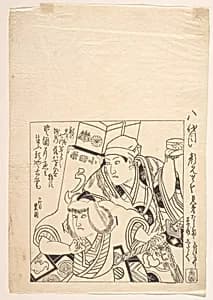
Shitaku and Sansho VII in Soga Kyodai (a Kabuki Play of the Soga Brothers)
Medium
Monochrome woodblock print; ink on paper
Dimensions
H. 10 1/2 in. (26.7 cm); W. 7 1/8 in. (18.1 cm)
Classification
Prints
Culture & Period
Japan · Edo period (1615–1868)
Department
Asian Art
Museum
Metropolitan Museum of Art, New York, NY
Credit
H. O. Havemeyer Collection, Bequest of Mrs. H. O. Havemeyer, 1929
Accession Number
JP1832
Rights
Public Domain
Tags
Art Historical Context
In the vibrant world of Edo-period Japan (1615–1868), Utagawa Toyuni I, a leading master of ukiyo-e woodblock prints, captured the dramatic flair of Kabuki theater. This monochrome print depicts actors Shitaku and Sansho in *Soga Kyodai*, a beloved play retelling the legendary tale of the Soga brothers revenge against their father's murderer. Toyokuni's yakusha-e (actor prints) immortalized star performers, blending artistry with popular culture and making theater accessible to everyday viewers through affordable prints. Crafted as a sumizuri-e—ink-only woodblock on paper—this intimate work (10½ × 7⅛ in.) showcases the precision of the ukiyo-e technique. Monochrome designs like this predated full-color nishiki-e, relying on bold lines and subtle shading to convey expressive poses, costumes, and emotional intensity. Toyokuni's dynamic compositions highlighted actors' mie (striking poses), turning static images into frozen moments of theatrical passion. Housed in the Metropolitan Museum of Art's Asian Art Department from the prestigious H.O. Havemeyer Collection, this print reflects Kabuki's cultural dominance and ukiyo-e's role in democratizing art. It invites us to appreciate how 19th-century Japan blurred lines between stage and street, performance and print.
About the Artist
Utagawa Toyokuni I · 1777–1835
Japanese, 1777–1835