
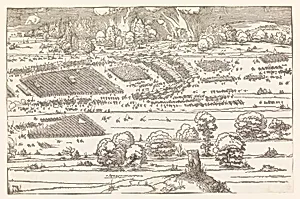
Siege of a City (Part 2)
Classification
landscapes
Department
Smithsonian Collection
Museum
Smithsonian American Art Museum
Credit
Smithsonian American Art Museum
Accession Number
1950-30-20-b
Rights
Public Domain
About this artwork
Research in Progress
Art Historical Context
Albrecht Dürer’s “Siege of a City (Part 2),” created in 1527, captures the artist’s lifelong fascination with landscape and human drama near the end of his career. As one of the most celebrated figures of the Northern Renaissance, Dürer brought remarkable precision and observation to his depictions of the natural and built world. This work, classified among his landscapes, likely portrays a fortified town under threat, blending architectural detail with the tension of conflict. Though its exact medium remains under research, the piece reflects Dürer’s innovative approach to perspective and spatial depth, skills he refined through extensive travels and study of Italian art. Created just a year before his death, it stands as a testament to his enduring curiosity about how cities and their surroundings shape human experience. Visitors can appreciate how Dürer elevated landscape from mere background to a central subject, influencing generations of artists who followed. His ability to infuse even a siege scene with atmospheric light and intricate detail invites viewers to consider both the grandeur and vulnerability of urban life in the early sixteenth century.