
Siena
1923
Medium
etching in black
Dimensions
plate: 11.11 × 10.95 cm (4 3/8 × 4 5/16 in.)
Classification
Department
CG-W
Museum
National Gallery of Art, Washington, D.C.
Credit
Rosenwald Collection
Accession Number
1943.3.966
Rights
Public Domain
Art Historical Context
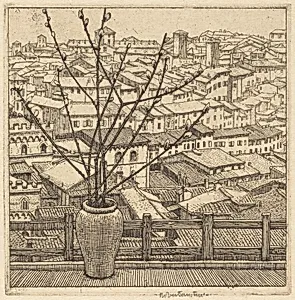
**Siena** by Robert Austin, created in 1923, is a delicate etching in black ink on a modest plate measuring just 11.11 × 10.95 cm. This intimate scale invites close contemplation, characteristic of fine printmaking from the interwar period. Housed in the National Gallery Art's Rosenwald Collection—a renowned assemblage of prints gifted by collector Lessing J. Rosenwald—this work exemplifies the precision of British graphic arts during a time of artistic renewal after World War I. Robert Austin (1895–1973), a distinguished English engraver and Royal Academician, mastered etching techniques that allowed acid to bite intricate lines into a metal plate, producing rich tonal contrasts and textures. His style blended traditional craftsmanship with a lyrical sensitivity, often evoking the charm of European locales. Titled *Siena*, the print likely captures the historic Tuscan city's medieval rooftops and winding streets, transporting viewers to Italy's enduring cultural heartland through Austin's masterful line work. As a classified print from the CG-W department, *Siena* highlights etching's democratic appeal—affordable multiples that brought artistry to wider audiences. Its presence in the NGA underscores Austin's role in preserving technical virtuosity amid modernism's rise, offering a timeless window into both artistic process and wanderlust.
About the Artist
Robert Austin · 1895–1973
Robert Sargent Austin RA PPRWS PPRE (1895–1973) was a preeminent British engraver, draughtsman, illustrator, and painter, born in Leicester, England, where his prodigious talent emerged early—at just eight years old, he exhibited with the Royal Drawing Society.) He trained first at the Leicester Municipal School of Art from 1909 to 1913, then at the Royal College of Art from 1914–1916 and 1919–192...