
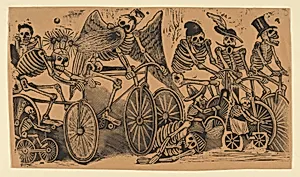
Skeletons (calaveras) riding bicycles
ca. 1900
Medium
Type-metal engraving
Dimensions
sheet: 6 1/16 x 10 9/16 in. (15.4 x 26.8 cm)
Classification
Prints
Department
Drawings and Prints
Museum
Metropolitan Museum of Art, New York, NY
Credit
Gift of Jean Charlot, 1930
Accession Number
30.82.112
Rights
Public Domain
Tags
Art Historical Context
Behold José Guadalupe Posada's *Skeletons (calaveras) riding bicycles*, whimsical yet poignant type-metal engraving from around 1900, now housed in the Metropolitan of Art's Drawings and Prints department. 6 1/16 x 10 9/16-inch print captures skeletal figures gleefully pedaling bicycles, blending the macabre with the modern in Posada's signature satirical style. As a master of Mexican broadsheet art, Posada (1852–1913) used these lively calaveras—skeletons derived from Day of the Dead traditions—to poke fun at everyday life, poking holes in social pretensions during Mexico's Porfirio Díaz era. The artwork's cultural punch lies in its irony: bicycles symbolized cutting-edge progress at the turn of the century, yet Posada reminds us that death levels all, rich or poor, rider or pedestrian. His calaveras became icons of Mexican popular culture, influencing later artists like Diego Rivera and embodying the nation's irreverent humor toward mortality. Crafted via type-metal engraving—a cheap, relief-printing technique Posada adapted from printing presses for mass broadsides—this piece exemplifies his genius for accessible, politically charged art. Gifted to the Met by Jean Charlot in 1930, it invites visitors to chuckle at the eternal dance of life and death.
About the Artist
José Guadalupe Posada · 1852–1913
José Guadalupe Posada (1852-1913) was a Mexican printmaker and engraver who revolutionized popular art and created some of the most iconic images in Mexican culture. Working primarily with publisher Antonio Vanegas Arroyo, he produced over 20,000 images during his career—inexpensive broadsheets sold for a penny on colored paper that made his art accessible to even the poorest workers. He transform...