
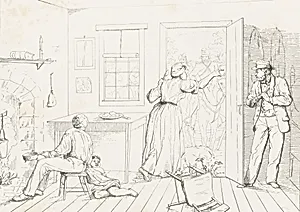
Slaves Concealing Their Master from a Search Party
Medium
Classification
Department
Smithsonian Collection
Museum
Smithsonian American Art Museum
Credit
National Portrait Gallery, Smithsonian Institution
Accession Number
NPG.79.95.F
Rights
Public Domain
Tags
Art Historical Context
In the midst of the American Civil War Adalbert John Volck a German-born dentist and skilled etcher living in Baltimore, created *Slaves Concealing Their from a Search Party* in 1863. This print captures a tense domestic scene: enslaved individuals urgently hiding their master—perhaps behind a door or in a shadowed corner of a room furnished with a fireplace, table, chairs, stools, candles, books, and a pistol— Union soldiers conduct a search outside, hinted at by the horse and military presence. Volck's meticulous etching technique allows for dramatic contrasts of light and shadow, emphasizing secrecy and loyalty in the flickering candlelight. As part of Volck's clandestine series *Sketches from the Civil War in America*, this work served as pro-Confederate propaganda, challenging Northern narratives by depicting enslaved Black people as devoted protectors of their white Southern master amid raids by Federal troops. Produced and distributed secretly due to Volck's sympathies in a Union-occupied city, the print reflects the era's deep divisions and the artist's technical prowess in small-scale, narrative-driven etchings that blended portraiture with political commentary. Today, housed in the Smithsonian American Art Museum's National Portrait Gallery collection, it offers a window into contested Civil War loyalties, reminding visitors of art's power to shape perceptions during national crisis.