
Smoking the Shield
1837-1839
Medium
Painting
Classification
Painting
Department
Smithsonian Collection
Museum
Smithsonian American Art Museum
Credit
Smithsonian American Art Museum, Gift of Mrs. Joseph Harrison, Jr.
Accession Number
1985.66.477
Rights
Public Domain
Tags
About this artwork
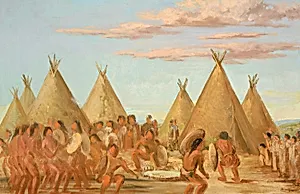
“The Sioux shield [is] made of the skin of the buffalo's neck, hardened with the glue extracted from the hoofs and joints of the same animal . . . This skin is at first, twice as large as the size of the required shield; but having got his particular and best friends (who are invited on the occasion) into a ring, to dance and sing around it, and solicit the Great Spirit to instil into it the power to protect him harmless against his enemies, [the young man] spreads over it the glue, which is rub...
Art Historical Context
George Catlin's *Smoking the Shield* (1837-1839), an oil painting from the Smithsonian American Museum, captures a sacred Sioux (Dakota) ritual on the Great Plains. Catlin, a pioneering 19th-century artist, traveled extensively among Native American tribes in the 1830s to document their vanishing traditions before westward expansion altered them forever. His realistic style, rooted in ethnographic observation, brings vivid life to Indigenous customs, making this work a vital historical record. The painting depicts the intricate process of crafting a warrior's shield from buffalo neck skin, hardened with glue from the animal's hooves and joints. As described in Catlin's *Letters and Notes* (1841), a young man invites friends to form a circle, dancing and singing to invoke the Great Spirit's protection. They apply glue to the oversized skin, stretched taut with pegs driven into the ground, which contract as it dries—shrinking to half its size and thickening into an impenetrable shield. This ceremonial act underscores the deep spiritual and communal bonds in Sioux culture. Through meticulous detail, Catlin highlights the ingenuity of Plains Indian craftsmanship, blending artistry with reverence for nature and the buffalo. A poignant reminder of pre-reservation life, it invites visitors to appreciate the resilience and beauty of Dakota traditions.
About the Artist
George Catlin · 1796–1872
George Catlin (1796–1872), born in Wilkes-Barre, Pennsylvania, to Putnam Catlin and Polly Sutton—who had been captured by Native Americans during the 1778 Battle of Wyoming—initially pursued a legal career. Trained at Litchfield Law School, he was admitted to the bar in 1819 but abandoned law after two years to study art in Philadelphia in 1823. Self-taught as a portraitist, Catlin quickly gained ...