
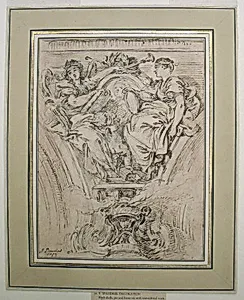
Spandrel Decoration: Fame and Truth Applauding Louis XV
Classification
architecture
Department
Smithsonian Collection
Museum
Smithsonian American Art Museum
Credit
Purchased for the Museum by the Advisory Council
Accession Number
1911-28-8
Rights
Public Domain
About this artwork
Research in Progress
Art Historical Context
François Boucher’sSpandrel Decoration: Fame and Truth Applauding Louis XV” captures the spirit of mid-eighteenth-century French decorative art. Created in 1753, the work was designed to fill the curved triangular space of a spandrel—an architectural element often found above arches in grand interiors. Boucher, a leading figure of the Rococo movement, specialized in elegant, light-hearted compositions that adorned royal residences and public buildings during the reign of Louis XV. The subject celebrates the French monarch through allegory: the figures of Fame and Truth raise their voices in praise, a common motif used to glorify rulers and reinforce their divine right. Although the exact medium remains unknown, the piece’s classification as architecture suggests it may have been a preparatory design or a painted panel integrated into a larger decorative scheme. Such works blended painting, sculpture, and architecture to create immersive environments that reflected the opulence and cultural ambitions of the French court. Acquired by the Smithsonian American Art Museum through its Advisory Council, the decoration offers visitors a glimpse into how art served both aesthetic and political purposes in eighteenth-century Europe. Boucher’s graceful style and the symbolic message together illustrate the era’s taste for refined ornament and royal flattery.