
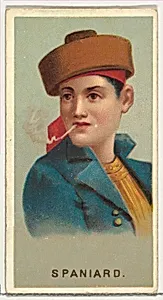
Spaniard, from World's Smokers series (N33) for Allen & Ginter Cigarettes
1888
Medium
Commercial color lithograph
Dimensions
Sheet: 2 3/4 x 1 1/2 in. (7 x 3.8 cm)
Classification
Prints|Ephemera
Department
Drawings and Prints
Museum
Metropolitan Museum of Art, New York, NY
Credit
The Jefferson R. Burdick Collection, Gift of Jefferson R. Burdick
Accession Number
63.350.202.33.50
Rights
Public Domain
Tags
Art Historical Context
Step into the vibrant world of 19th-century advertising with *Spaniard, from World's Smokers series (N) for Allen & G Cigarettes* (1888), a petite commercial color lithograph measuring just 2¾ x 1½ inches. Produced by the pioneering tobacco firm Allen & Ginter, this card is part of a popular series inserted into cigarette packs, enticing smokers with colorful depictions of men from around the globe puffing away. Here, a mustachioed Spaniard embodies exotic allure, his elaborate attire and pipe evoking the romanticized internationalism of the Gilded Age. Chromolithography, the medium's star technique, allowed for vivid, mass-produced color printing—a technological marvel that made these ephemera affordable and irresistible. Allen & Ginter's cards sparked a collecting craze among adults and children alike, transforming everyday smokes into tradable treasures and foreshadowing modern baseball cards. Part of The Metropolitan Museum of Art's Jefferson R. Burdick Collection, this piece highlights how commerce intertwined with visual culture, glamorizing smoking amid rising tobacco popularity. Culturally, it reflects late Victorian fascination with global types, blending imperialism's gaze with clever marketing. A tiny window into how art served industry, it reminds us that even fleeting ads can endure as historical gems.
About the Artist
Allen & Ginter
Allen & Ginter, the pioneering American tobacco firm based in Richmond, Virginia, emerged around 1880 from the partnership of John F. Allen and Lewis Ginter, evolving from Allen's earlier John F. Allen & Company. Allen retired in 1882, succeeded by John Pope, yet the brand endured under Ginter's leadership, employing over 1,100 workers—mostly women—for hand-rolled cigarettes by 1886. Ginter, a Dut...