
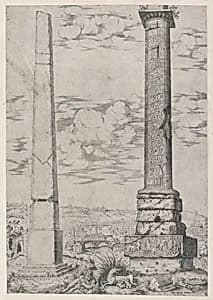
Speculum Romanae Magnificentiae: Column of Antoninus and a Roman Obelisk
Medium
Engraving
Dimensions
mount: 22 1/8 x 16 13/16 in. (56.2 x 42.7 cm) sheet: 18 3/16 x 12 5/8 in. (46.2 x 32.1 cm)
Classification
Prints
Department
Drawings and Prints
Museum
Metropolitan Museum of Art, New York, NY
Credit
Harris Brisbane Dick Fund, 1941
Accession Number
41.72(1.102)
Rights
Public Domain
Tags
Art Historical Context
This engraving from the *Speculum Romanae Magnificentiae* captures two iconic Roman monuments—the Column of Antoninus and an ancient obelisk—set amid a lively scene of ruins, flowing streams, and everyday figures including men, infants, and dogs. Created around 1543–1570, the print belongs to a celebrated series that documented the architectural wonders of ancient Rome. Produced through the intricate medium of engraving, it allowed for precise architectural details, from ornate column capitals to the towering obelisk, while evoking the atmospheric qualities of clouds and landscape. The *Speculum Romanae Magnificentiae*, compiled and published by Antonio Lafreri with contributions from artists like Enea Vico and anonymous Italian engravers, served as a visual encyclopedia for 16th-century travelers and scholars. At a time when interest in classical antiquity surged during the Renaissance, these prints helped preserve and popularize Rome’s decaying heritage, blending accurate representation with imaginative reconstruction of the ancient city. Beyond their documentary value, such engravings played a vital cultural role by making Rome’s grandeur accessible to audiences across Europe. The inclusion of human activity amid the ruins highlights the enduring life surrounding these monuments, inviting viewers to connect with the layered history of the Eternal City.
About the Artist
Enea Vico|Anonymous, Italian, 16th century|Antonio Lafreri · 1523–1567
Enea Vico (1523–1567) was born in Parma and came of age during the final, energetic decades of Italian Renaissance printmaking. By 1541 he had made his way to Rome, where he entered the orbit of the engraver and publisher Tommaso Barlacchi and began his professional career. In Rome, Vico encountered the work of the most celebrated printmakers of the preceding generation—Marcantonio Raimondi, Agost...