
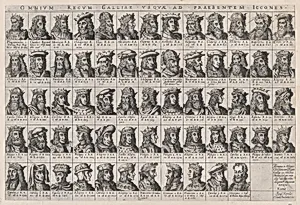
Speculum Romanae Magnificentiae: Small Portraits of the French Kings from Pharamond to Henri III
Medium
Engraving
Dimensions
sheet: 11 7/8 x 17 11/16 in. (30.1 x 45 cm) mount: 14 15/16 x 21 1/4 in. (38 x 54 cm)
Classification
Prints
Department
Drawings and Prints
Museum
Metropolitan Museum of Art, New York, NY
Credit
Harris Brisbane Dick Fund, 1941
Accession Number
41.72(3.99)
Rights
Public Domain
Tags
About this artwork
Speculum Romanae Magnificentiae: Small Portraits of the French Kings from Pharamond to Henri III by Claudio Duchetti|Anonymous, 1586. Created in Engraving, this work exemplifies the artistic practices and cultural values of its period. The piece reflects the technical skills and aesthetic sensibilities characteristic of its historical and cultural context. As part of the Drawings and Prints collection, it contributes to our understanding of artistic development and cultural expression. The work ...
Art Historical Context
Step into the Renaissance world of printed grandeur with *Speculum Romanae Magniae: Small Portraits of the French Kings from Phond to Henri III*1586), an engraving attributed to publisher Claudio Duchetti and anonymous collaborators. Measuring nearly 12 by 18 inches on its sheet, this intricate print is part of the celebrated *Speculum* series from 16th-century Rome—a visual catalog celebrating antiquity, emperors, and illustrious figures. Housed in the Metropolitan Museum of Art's Drawings and Prints collection, it captures a lineage of French monarchs from the legendary Pharamond, first king of the Franks, to the contemporary Henri III. Engraving, a precise intaglio technique where lines are incised into a metal plate and inked for transfer to paper, allowed for remarkable detail in these diminutive portraits. Produced amid Rome's vibrant printmaking scene, the work reflects the era's fascination with history and dynastic legitimacy, linking mythical origins to Renaissance rulers. Publishers like Duchetti compiled such images into bespoke albums, making elite iconography accessible to collectors across Europe. As both an artistic tour de force and historical document, this print underscores the cultural prestige of monarchy and the power of prints to preserve legacy. It invites us to ponder how visual storytelling bridged ancient myths and modern power in the late 16th century.
About the Artist
Claudio Duchetti|Anonymous ( |Italian) · |1565 – |1585
|Italian, active Venice and Rome, ca. 1565–died ca. 1585