
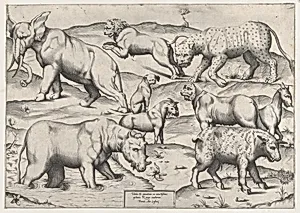
Speculum Romanae Magnificentiae: Wild Animals, from antique wall paintings, plate 2
Medium
Engraving
Dimensions
sheet: 12 x 16 3/4 in. (30.5 x 42.6 cm) mount: 14 5/8 x 20 3/16 in. (37.2 x 51.2 cm)
Classification
Prints
Department
Drawings and Prints
Museum
Metropolitan Museum of Art, New York, NY
Credit
Harris Brisbane Dick Fund, 1941
Accession Number
41.72(2.179)
Rights
Public Domain
Tags
About this artwork
"Speculum Romanae Magnificentiae: Wild Animals, from antique wall paintings, plate 2" by Antonio Lafreri|Anonymous|Antonio Lafreri, created in 1547, is executed in engraving. This prints belongs to the Metropolitan Museum's Drawings and Prints collection. The work measures sheet: 12 x 16 3/4 in. (30.5 x 42.6 cm) mount: 14 5/8 x 20 3/16 in. (37.2 x 51.2 cm). The artwork entered the museum's collection through harris brisbane dick fund, 1941.
Art Historical Context
Step into the Renaissance fascination with ancient Rome through *Speculum Romanae Magniae: Wild Animals, antique wall paintings, plate2*, an engraving published by Antonio Lafreri 1547. This captures vivid depictions of fierce wild animals—likely lions, tigers, or other beasts—drawn from rediscovered Roman frescoes, showcasing the grandeur of antiquity. Lafreri, a prominent Roman publisher and engraver, collaborated with anonymous artists to reproduce these motifs, evoking the exotic menageries that once adorned imperial villas and public spaces. As plate 2 from the renowned *Speculum Romanae Magnificentiae* ("Mirror of Roman Magnificence"), this work was part of a groundbreaking series of over 400 prints compiled between 1540 and 1570. It reflects the 16th-century humanist revival, where scholars and artists eagerly documented classical ruins to celebrate Rome's enduring legacy amid the city's post-medieval rediscovery. These engravings served as visual encyclopedias, inspiring architects, painters, and collectors across Europe. Crafted in the precise medium of engraving on a generous sheet (12 x 16 3/4 inches), the technique allowed for intricate details and widespread dissemination—revolutionary for its time. Today, housed in the Metropolitan Museum of Art's Drawings and Prints department (acquired via the Harris Brisbane Dick Fund, 1941), it invites us to marvel at how Renaissance ingenuity bridged ancient splendor and modern curiosity.
About the Artist
Antonio Lafreri|Anonymous|Antonio Lafreri · 1507–1577
Antonio Lafreri, born Antoine du Pérac Lafréry around 1512 in Orgelet in the County of Burgundy (modern-day France), emerged as one of the most influential print publishers of the 16th century after settling in Rome around 1540. His early life and training remain sparsely documented, with no records of specific teachers or art schools; he arrived in the Eternal City as an engraver, producing works...