
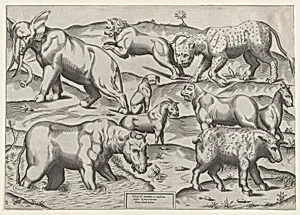
Speculum Romanae Magnificentiae: Wild Animals, from antique wall paintings, plate 2
late 16th century
Medium
Engraving
Dimensions
sheet: 11 5/8 x 16 9/16 in. (29.6 x 42 cm)
Classification
Prints
Department
Drawings and Prints
Museum
Metropolitan Museum of Art, New York, NY
Credit
Harris Brisbane Dick Fund, 1941
Accession Number
41.72(2.178)
Rights
Public Domain
Tags
Art Historical Context
Step into the grandeur of ancient Rome through *Speculum Romanae Magniae: Wild Animals, antique wall paintings, plate2*, a captivating late 16th-century engraving housed in the Metropolitan Museum of Art's Drawings and Prints department. large sheet (11 5/8 x 16 9/16 in.) vividly captures fierce boars, majestic elephants, and roaring lions, faithfully reproducing motifs from long-lost Roman wall paintings. by Antonio Lafreri and Claudio Duchetti, with anonymous engraving, it belongs to Lafreri's renowned *Speculum Romanae Magnificentiae*—a pioneering anthology of over 500 prints celebrating Rome's imperial splendor. Engravings like this were revolutionary in the Renaissance, enabling precise dissemination of classical imagery across Europe. By translating fragile frescoes into durable prints, artists preserved the exotic menagerie that once adorned Roman villas, symbolizing power, spectacle, and the empire's dominion over nature. These wild beasts, evoking triumphs and arenas, highlight how 16th-century scholars and collectors revived antiquity to inspire their own era's art and architecture. Acquired through the Harris Brisbane Dick Fund in 1941, this plate invites us to marvel at Rome's enduring legacy, bridging millennia with intricate lines that pulse with primal energy.
About the Artist
Antonio Lafreri|Anonymous|Claudio Duchetti · 1507–1577
Antonio Lafreri, born Antoine du Pérac Lafréry around 1512 in Orgelet in the County of Burgundy (modern-day France), emerged as one of the most influential print publishers of the 16th century after settling in Rome around 1540. His early life and training remain sparsely documented, with no records of specific teachers or art schools; he arrived in the Eternal City as an engraver, producing works...