
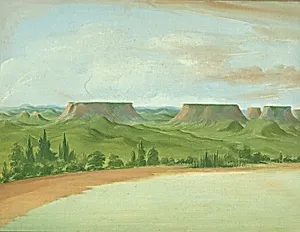
Square Hills, 1200 Miles above St. Louis
1832
Medium
Painting
Classification
Painting
Department
Smithsonian Collection
Museum
Smithsonian American Art Museum
Credit
Smithsonian American Art Museum, Gift of Mrs. Joseph Harrison, Jr.
Accession Number
1985.66.395
Rights
Public Domain
Tags
About this artwork
“An hundred miles above [Belle Vue], I passed a curious feature, called the ‘Square Hills’ . . . On ascending them I found them to be two or three hundred feet high, and rising on their sides at an angle of 45 degrees; and on their tops, in some places, for half a mile in length, perfectly level, with a green turf, and corresponding exactly with the tabular hills spoken of above the Mandans.” (Catlin, Letters and Notes, vol. 2, no. 32, 1841; reprint 1973)
Art Historical Context
George Catlin's *Square Hills, 120 Miles above St. Louis* (1832) captures a striking geological wonder along the Missouri River, painted during the artist's epic journey into the American West. As a pioneering documentarian of Native American life and untamed landscapes, Catlin thousands of miles by steamboat and canoe in the early 1830s, scenes that would soon vanish under waves of settlement. This oil painting depicts the "Square Hills," a cluster of flat-topped buttes rising dramatically from the riverbanks, evoking the vast, primal beauty of the frontier. In his own words from *Letters and Notes on the Manners, Customs, and Condition of the North American Indians* (1841), Catlin described passing these hills about 100 miles above Belle Vue: two to three hundred feet high with 45-degree slopes and level, turf-covered summits stretching half a mile. He likened them to the tabular hills near the Mandan villages upstream, highlighting their rarity and the sense of discovery. As part of the Smithsonian American Art Museum's collection (gift of Mrs. Joseph Harrison, Jr.), the work exemplifies Catlin's realist style—precise, vivid, and ethnographic—preserving a snapshot of pre-industrial America for future generations. This painting not only showcases natural splendor but underscores the cultural urgency of Catlin's mission: to record a disappearing wilderness and its indigenous inhabitants before Manifest Destiny reshaped the continent.
About the Artist
George Catlin · 1796–1872
George Catlin (1796–1872), born in Wilkes-Barre, Pennsylvania, to Putnam Catlin and Polly Sutton—who had been captured by Native Americans during the 1778 Battle of Wyoming—initially pursued a legal career. Trained at Litchfield Law School, he was admitted to the bar in 1819 but abandoned law after two years to study art in Philadelphia in 1823. Self-taught as a portraitist, Catlin quickly gained ...