
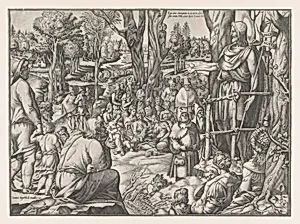
St. John Preaching in the Desert
1535–55
Medium
Etching
Dimensions
Sheet (trimmed): 12 1/2 × 16 7/8 in. (31.8 × 42.8 cm)
Classification
Prints
Department
Drawings and Prints
Museum
Metropolitan Museum of Art, New York, NY
Credit
The Elisha Whittelsey Collection, The Elisha Whittelsey Fund, 1949
Accession Number
49.95.184
Rights
Public Domain
Tags
Art Historical Context
In the mid-16th century, the elegant Mannerist phase of the Fontainebleau School in France, artists Luca Penni and Jean M collaborated on *St. John Preaching the Desert*, an etching capturing the biblical prophet's fervent sermon amid a diverse crowd of men and women gathered beneath desert trees. Dated between 1535 and 1555, this work reflects the era's fascination with religious narratives, blending Italian Renaissance influences with French courtly sophistication as Penni, an Italian émigré, and Mignon, a skilled engraver, worked under royal patronage at Fontainebleau. Etching, the medium here, was a revolutionary printmaking technique popularized in the 16th century, where acid bites into a metal plate to create fluid, expressive lines—ideal for the intricate, dynamic compositions of Mannerism. This large sheet (trimmed to 12½ × 16⅞ inches) showcases their mastery in rendering elongated figures, dramatic gestures, and a teeming crowd, evoking spiritual intensity and communal devotion. Prints like this democratized art, allowing widespread dissemination beyond elite workshops. Housed in the Metropolitan Museum of Art's Drawings and Prints department through The Elisha Whittelsey Collection, this piece highlights the cultural role of religious imagery during a time of Reformation tensions, inviting viewers to ponder St. John the Baptist's call to repentance in a visually captivating tableau.
About the Artist
Luca Penni|Jean Mignon · 1500–1557
Comment on works: Religious