
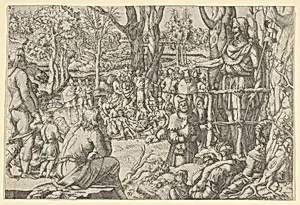
St. John Preaching in the Desert
1535–55
Medium
Etching
Dimensions
4 15/16 x 7 5/16 in. (12.6 x 18.6 cm)
Classification
Prints
Department
Drawings and Prints
Museum
Metropolitan Museum of Art, New York, NY
Credit
The Elisha Whittelsey Collection, The Elisha Whittelsey Fund, 1949
Accession Number
49.95.185
Rights
Public Domain
Tags
Art Historical Context
In the mid-16th century, the elegant Mannerist phase of the French Renaissance, artists Luca Penni and Jean Mignon collaborated on *St. John Preaching in Desert*, an exquisite etching from around 1535–55. Penni, an Italian-born painter who worked at the Fontainebleau court under Francis I, and Mignon, a skilled French printmaker, drew from the innovative School of Fontainebleau This movement blended Italian Renaissance grace with French sophistication, producing intricate designs that spread royal tastes through affordable prints. The scene captures the biblical prophet St. John the Baptist gesturing passionately amid a rapt crowd in a barren wilderness, emphasizing themes of repentance and divine call. Etching's fluid technique—using acid to etch fine lines into a metal plate—allowed for the delicate, swirling drapery and expressive figures typical of Mannerism, evoking Raphael's influence while heightening emotional drama. At just 4 15/16 x 7 5/16 inches, its intimate scale made it ideal for collectors' albums. Housed in the Metropolitan Museum of Art's Elisha Whittelsey Collection, this print highlights prints' role in democratizing art during the Reformation era, when religious imagery like St. John's sermons resonated deeply. A testament to technical virtuosity, it invites visitors to ponder faith's enduring power in a stylish, golden age of European engraving.
About the Artist
Luca Penni|Jean Mignon · 1500–1557
Comment on works: Religious