
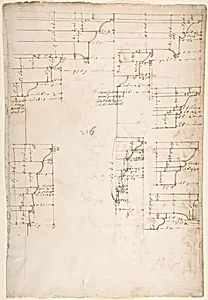
St. Peter's, tribune, exterior, entablature and cornice details (recto)Santa Maria Maggiore, Sforza Chapel, plan, detail (verso)
early to mid-16th century
Medium
Dark brown ink, black chalk, and incised lines
Dimensions
sheet: 17 1/8 x 11 9/16 in. (43.5 x 29.3 cm)
Classification
Drawings
Department
Drawings and Prints
Museum
Metropolitan Museum of Art, New York, NY
Credit
Gift of Janos Scholz and Anne Bigelow Scholz, in memory of Flying Officer Walter Bigelow Rosen, RCAF, 1949
Accession Number
49.92.19
Rights
Public Domain
Tags
Art Historical Context
This exquisite double-sided architectural drawing from early to mid-16th France captures the keen Renaissance fascination with classical Roman design. On the recto, meticulous details of the exterior entablature and cornice from St. Peter's Basilica's tribune showcase the grandeur of Rome's premier basilica, then undergoing transformative renovations under architects like Bramante and Michelangelo. The verso features a precise plan detail of the Sforza Chapel Santa Maria Maggiore, another of papal Rome, highlighting ornate chapel layouts favored by powerful families. Executed by an anonymous French artist in dark brown ink, black chalk, and incised lines on a sheet measuring 17 1/8 x 11 9/16 inches, the work reveals sophisticated drafting techniques. The incised lines—subtle grooves scratched into the surface—suggest it served as a practical transfer pattern, allowing motifs to be traced onto other surfaces, a common method for disseminating architectural ideas across Europe. Housed in the Metropolitan Museum of Art's Drawings and Prints department, this gift from Janos and Anne Bigelow Scholz honors a fallen WWII hero. It offers a window into how French designers studied and adapted Italy's architectural innovations, bridging the gap between observation and creation in the dawn of the High Renaissance.