
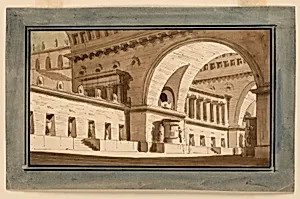
Stage Design, Exterior of Palace, Sepulchral Hall
early 19th century
Classification
theater
Department
Smithsonian Collection
Museum
Smithsonian American Art Museum
Credit
Museum purchase through gift of various donors and from Eleanor G. Hewitt Fund
Accession Number
1938-88-241
Rights
Public Domain
About this artwork
Research in Progress
Art Historical Context
**Stage Design: Exterior of Palace Sepulchral Hall *Angelo Toselli (ca. 1765?–1826), early 19th century* Step into the dramatic world of early 19th-century theater with this evocative stage design by Italian artist Angelo Toselli. Titled *Exterior of Palace, Sepchral Hall*, it captures a grand architectural facade blending palatial splendor with a haunting, tomb-like atmosphere—perfect for tragic operas or Gothic plays popular in the era. Toselli, a skilled scenic designer, crafted such visions to transform bare stages into immersive realms, drawing on neoclassical and romantic influences to evoke emotion and scale. Though the medium remains unidentified amid ongoing research, these designs were typically rendered in gouache or watercolor on paper, allowing for luminous effects and precise architectural details. In an age when theater was a cultural powerhouse, Toselli's work highlighted the rising art of scenography, where scenery rivaled actors in storytelling power. This piece, now in the Smithsonian American Art Museum (museum purchase through various donors and the Eleanor G. Hewitt Fund), offers a window into Europe's vibrant stagecraft tradition. Imagine the gaslit glow illuminating this sepulchral palace as audiences gasped— a testament to how visual spectacle shaped public imagination before modern effects. Research continues to uncover more about Toselli's career, making this a tantalizing artifact for theater enthusiasts.