
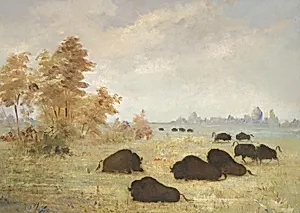
Stalking Buffalo, Arkansas
1846-1848
Medium
Painting
Classification
Painting
Department
Smithsonian Collection
Museum
Smithsonian American Art Museum
Credit
Smithsonian American Art Museum, Gift of Mrs. Joseph Harrison, Jr.
Accession Number
1985.66.599
Rights
Public Domain
Tags
About this artwork
“The buffalo bull often grows to the enormous weight of 2000 pounds, and shakes a long and shaggy black mane, that falls in great profusion and confusion, over his head and shoulders; and oftentimes falling down quite to the ground. The horns are short, but very large, and have but one turn, i.e. they are a simple arch, without the least approach to a spiral form, like those of the common ox, or of the goat species . . . One of the most remarkable characteristics of the buffalo, is the peculiar ...
Art Historical Context
George Catlin's *Stalking Buffalo, Arkansas* (1846–184) captures the raw drama of the American West during a time of rapid transformation. A pioneering artist and ethnographer, Catlin traveled extensively among Native American tribes in the 1830s, sketching and painting the landscapes, peoples, and wildlife of the frontier before industrialization and westward expansion altered them forever. This oil painting, now in the Smithsonian American Art Museum, reflects his commitment to documenting the vanishing wilderness, with a focus on the mighty buffalo—central to Plains Indian sustenance and culture. The scene depicts a tense moment of a male hunter stalking a massive buffalo bull in Arkansas territory, embodying Catlin's meticulous observation of nature. Drawing from his own vivid descriptions in *Letters and Notes on the Manners, Customs, and Conditions of the North American Indians* (1841), Catlin highlights the animal's shaggy black mane cascading to the ground, short yet formidable arched horns, and striking eyes—large white orbs with jet-black irises that glare fiercely beneath strained lids. His realistic style, rooted in Romanticism, blends scientific precision with dramatic tension, making the buffalo not just prey, but a symbol of untamed power. This work underscores the ecological and cultural stakes of 19th-century America, where buffalo herds numbered in the tens of millions before overhunting led to near-extinction. Catlin's art serves as both aesthetic marvel and urgent historical record, inviting visitors to ponder the fragile balance of humanity and nature.
About the Artist
George Catlin · 1796–1872
George Catlin (1796–1872), born in Wilkes-Barre, Pennsylvania, to Putnam Catlin and Polly Sutton—who had been captured by Native Americans during the 1778 Battle of Wyoming—initially pursued a legal career. Trained at Litchfield Law School, he was admitted to the bar in 1819 but abandoned law after two years to study art in Philadelphia in 1823. Self-taught as a portraitist, Catlin quickly gained ...