
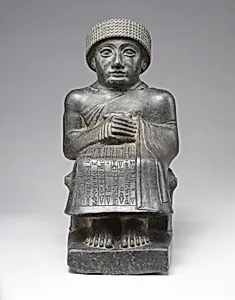
Statue of Gudea, named “Gudea, the man who built the temple, may his life be long”
Unknown Artist
ca. 2090 BCE
Medium
Diorite
Dimensions
17 5/16 × 8 7/16 × 11 5/8 in. (44 × 21.5 × 29.5 cm)
Classification
Stone-Sculpture-Inscribed
Culture & Period
Neo-Sumerian · Neo-Sumerian
Department
Ancient Near Eastern Art
Museum
Metropolitan Museum of Art, New York, NY
Credit
Harris Brisbane Dick Fund, 1959
Accession Number
59.2
Rights
Public Domain
Tags
Art Historical Context
This remarkable diorite statue portrays Gudea, prominent ruler of the city-state of Lagash during the Neo-Sian period around 2090 BCE. The inscription on the figure—“Gudea, the man who built the temple, may his life be long”—identifies him as a devout leader celebrated for his extensive temple-building projects, which helped restore Sumerian religious and cultural traditions after periods of upheaval in ancient Mesopotamia. Such works served both as votive offerings and lasting memorials, linking the ruler’s piety to the prosperity of his realm. Carved from durable diorite, a hard imported stone prized for its fine grain and ability to hold intricate details, the sculpture exemplifies the technical skill of Neo-Sumerian artisans. Its compact, seated pose with clasped hands conveys humility and reverence, characteristics typical of royal portraits meant to stand in temple sanctuaries. The smooth surfaces and precise rendering of the ruler’s garment and features highlight the period’s emphasis on idealized, enduring representations of power and devotion. Today housed in the Metropolitan Museum of Art’s collection of Ancient Near Eastern Art, this inscribed statue offers visitors a direct connection to one of Mesopotamia’s most revered builder-kings and the artistic traditions that shaped early urban civilizations.