
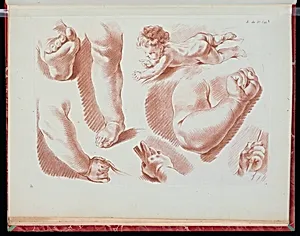
Studies of a Leg, Foot, Arms, Hands, and a Baby
Classification
Department
Smithsonian Collection
Museum
Smithsonian American Art Museum
Credit
Purchased for the Museum by the Advisory Council
Accession Number
1921-6-437-15
Rights
Public Domain
About this artwork
Research in Progress
Art Historical Context
Pierre Thomas Le Clerc, a French artist active from around 1740 to 1796, created *Studies of a Leg, Foot, Arms, Hands, and a Baby* in 1773. This print captures the artist's keen focus on human anatomy through detailed sketches of isolated body parts, including a tender depiction of a baby. Such studies were a cornerstone of artistic training in 18th-century Europe, allowing draftsmen to master proportion, movement, and realism before tackling full compositions. In the context of Enlightenment-era France, Le Clerc's work reflects the period's growing emphasis on empirical observation and scientific precision in art. Prints like this one—likely produced via engraving or etching techniques common at the time—served as affordable models for students and fellow artists, disseminating anatomical knowledge beyond studio walls. The inclusion of a baby's form adds a touch of intimacy, hinting at studies for portraiture or domestic scenes amid the Rococo-to-Neoclassical shift. Acquired for the Smithsonian American Art Museum by the Advisory Council, this piece enriches the collection's exploration of international printmaking traditions. With ongoing research, it invites visitors to appreciate the meticulous groundwork behind classical figure drawing, bridging French artistic heritage with American curatorial interests.