
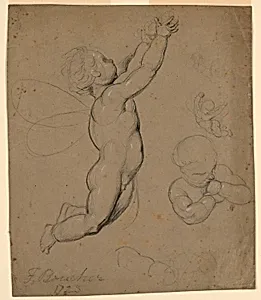
Studies of putti
Classification
figures
Department
Smithsonian Collection
Museum
Smithsonian American Art Museum
Credit
Gift of Hugh Cassel
Accession Number
1958-143-47
Rights
Public Domain
About this artwork
Research in Progress
Art Historical Context
François Boucher, one of the most celebrated French artists of the eighteenth century, created this delicate study of putti in 1770, the final year of his life. As a leading figure of the Rococo movement, Boucher was renowned for infusing his works with graceful movement, soft lighting, and a playful sensuality. Putti—cherubic, childlike figures drawn from classical mythology—frequently appear in his paintings as symbols of love, innocence, and divine joy, often accompanying Venus or other allegorical scenes. The title “Studies of putti” suggests these are preparatory drawings or sketches, offering visitors a rare glimpse into the artist’s working process. Such studies allowed Boucher to explore poses, expressions, and groupings before incorporating them into larger decorative or mythological compositions favored by royal and aristocratic patrons. Though the medium remains unspecified, the work’s classification as “figures” highlights its focus on the human form rendered with characteristic Rococo elegance. Housed in the Smithsonian American Art Museum through the generosity of Hugh Cassel, this piece invites contemplation of how even seemingly lighthearted motifs carried deeper cultural resonance in pre-Revolutionary France. Research continues on this late work, enriching our understanding of Boucher’s enduring influence.