
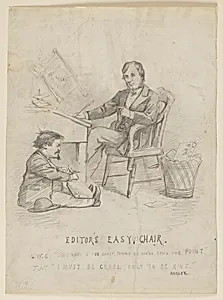
Study for Cartoon, "Editor's Easy Chair"
Classification
figures
Department
Smithsonian Collection
Museum
Smithsonian American Art Museum
Credit
Gift of Cooper Union Library
Accession Number
1953-10-47
Rights
Public Domain
About this artwork
Research in Progress
Art Historical Context
Thomas Nast, the German-born American caricaturist (1840–1902), was a towering figure in 19th-century journalism, for his biting political cartoons in *Harper Weekly*. Active during the Civil War and Reconstruction eras, Nast helped shape public opinion on issues like corruption and civil rights, famously popularizing the Democratic donkey and Republican elephant symbols. Created in 187, *Study for Cartoon, " Easy Chair"* is a drawing from his prolific output, likely sketching figures for a satirical piece tied to the "Editor's Easy Chair"—a witty literary feature in *Harper's Monthly Magazine* by George William Curtis. As a study classified under "figures," this work reveals Nast's methodical process: rough compositions honing exaggerated forms and expressive poses that amplified his social critiques. Though the medium is unknown, such preparatory sketches were typically pencil or ink on paper, allowing rapid iteration before final wood-engraved publication. Nast's bold lines and caricatured anatomy made complex ideas accessible, influencing modern editorial cartooning. Housed in the Smithsonian American Art Museum (gift of Cooper Union Library), this piece offers a glimpse into the behind-the-scenes artistry of Gilded Age commentary. Research continues, but it underscores Nast's role in blending art with activism, inviting us to ponder the "easy chair" as a metaphor for reflective—or perhaps complacent—power.